# What is flomo
flomo is the Next Generation Notes, focusing on helping you record more ideas , not more complex articles.

## flomo's features
What truly matters is your thoughts not your notes.
Most note-taking apps have fallen into a trap of adding powerful features such as Editing, Clipper, and even All-in-one, but few of them remember that the ultimate goal of note-taking is to inspire thoughts.

So we have developed these features:
* ✍️ Fast and powerful input via Kindle, Raycast, etc. based on API [→](/api/api-url-scheme)
* ⚙️ Deep customization of your daily reviews [→](/advanced/daily-review)
* 📚 An idea hub where you can tag, explore, annotate, and link each other [→](/basic/tags)
* ✈️ Export (all your ideas and highlights) to Notion and Html [→](broken://pages/b3Qy5OpFrlQR6y0sBOBP)
* 😀 Full platform sync (iOS/Android/Web/PWA/MAC) [→](/basic/download)
* 🚫 No ads or privacy sharing [→](#about-us)
We also have a number of mindsets for you
* [The Myths about Note-taking](/mindset/the-myths-about-note-taking)
* [What Knowledge Should be Accumulated?](/mindset/what-knowledge-should-be-accumulated)
* [The Definition of Knowledge and Its Management](/mindset/the-definition-of-knowledge-and-its-management)
* [Why Should We Use Cards for Note-taking](/mindset/why-should-we-use-cards-for-note-taking)
* [How to Organize Your Tags with I.A.R.P](/mindset/how-to-organize-your-tags-with-i.a.r.p)
* [Why Is Adding to Favorites Useless?](/mindset/why-is-adding-to-favorites-useless)
[Learn more about flomo PRO](/about-pro/flomo-pro)
## Why we developed flomo
During our career life, I found many people did not take notes or memos. Not because they don't want to, it was these apps! Most tools fell into a trap: focusing on a better writing experience, not connecting knowledge.
While the truth is that only a few people would become writers, however thinking better is more important for the rest.
Compared with how to connect knowledge and write essays, what we lack is to abstract information and ideas out of memos.
As McLuhan mentioned, "we shape our tools thereafter our tools shape us."
In flomo, there is no powerful customization, like Notion; or a bidirectional link system, like Roam; or a Markdowm editor, like Bear.
But flomo focuses on One thing: Helping you write down more MEMOs, with One goal: to build your own think flow.
## The philosophy of flomo
Thanks to these pioneers' ideas for our design
* [Niklas Luhmann](https://en.wikipedia.org/wiki/Niklas_Luhmann)
* [Alan Kay](https://en.wikipedia.org/wiki/Alan_Kay)
* [Doug Engelbart](https://en.wikipedia.org/wiki/Douglas_Engelbart)
* [Andy Matuschak](https://andymatuschak.org/)
## We are not good at
Never All in one, flomo only focus on taking and organizing MEMOs.That's why we recommend following apps:

## About Us
> "The best way to predict the future is to invent it," \
> by Alan Kay(1989)
Growing out from today's mist, we hope to make a note-taking tool of inspiring thoughts. Welcome to be one of us, and to enrich your knowledge in the future.
As independent developers, we care about your privacy. We will never sell your private info to any third party for profit.
You can review our [Privacy Policy](/terms-and-privacy/privacy) and [Terms](/terms-and-privacy/terms).
## Feedback
We're looking forward to your feedback. [Click here to give feedback.](http://flomoapp.mikecrm.com/n8Q5VtN) Or join our [discord](https://discord.gg/z2wHUKjab2)
# FAQ
## What platforms does flomo support?
* iPhone / Android
* Web / PWA (Win/Mac/iPad)
[Download here](/basic/download)
## Do flomo employees have access to my data?
**No.** Any data in our database is protected by technology and rules. As a small start-up, all of our revenue relies on the PRO subscription. Therefore, to provide you an ad-proof and private user experience is important.
* In technology, flomo uses the standard SSL and sets a strict data security standard. You can see details.
* In rules, flomo promises that no users' privacy will be snooped.
you can see our [Privacy Policy](/terms-and-privacy/privacy)
## How to export data from flomo
Exporting data is currently exclusive to PRO members, but don't worry, any newly sign-up users will have at least 14 days of PRO membership. You can gain bonus membership through using features.
You can find the Export button at the bottom of the Settings - Account

You will be notified when the export is successful, and when you open the flomo homepage, you will see that a new MEMO has been automatically created, containing the download link.
## Low browser cache space
Just follow the instructions
## Feedback
We're looking forward to your feedback. [Click here to give feedback.](http://flomoapp.mikecrm.com/n8Q5VtN) Or join our [discord](https://discord.gg/z2wHUKjab2)
# Tags
Tag system of flomo is unique. Not only can you set tags in hierarchy, but use tags as part of the body content.
Here's how it works.
## How to create a new tag
You can create a new tag by clicking the "#" button below the input box, or by typing the "#" sign directly from keyboard. For example, #tag (end with a space).
Click the Send button when you are done, and a new tag is created successfully.

## How to create multi-level tags
flomo supports a `#tag/subtag` syntax, which is easy to set and navigate tags. For example, if we want to set tags about book Different under tag `#Books`, and keep tags about a few chapters from the book, then we could write `#Books/Different/Marketing_Myoipa`. This is equal to create a tertiary tag.

## How to modify tags
Currently, only web version supports modifying tags. The feature on app version will come soon.
* **Modify one MEMO:** move the cursor to the tag, and modify the MEMO directly.
* **Modify a batch MEMO:** click the left menu bar to enter the tag list, click the "pencil" symbol behind the tag name in the headline (currently only available on the web version).

Here you can modify not only the tag content, but also the tag level. For example, if you want to put #Happiness under the tag #Life, you can directly modify it to #Life/Happiness
## How to add tags ICON
You can change it by clicking on the icon in front of the tag (PRO feature only).
[Click here to see what flomo PRO is](/about-pro/flomo-pro)

## How to delete tags
* **Delete one MEMO**: directly edit memo and delete the corresponding tag.
* **Delete a batch MEMO**: Not supported yet
## Feedback
We're looking forward to your feedback. [Click here to give feedback.](http://flomoapp.mikecrm.com/n8Q5VtN) Or join our [discord](https://discord.gg/z2wHUKjab2)
# Storage
You can check the storage and switch the compress mode in Settings - Account.
## Storage rules
* Free users: 500M storage. The images will be compressed.
* PRO members: 20G storage. The original images can be switched to upload.
[Click here to see what flomo PRO is](/about-pro/flomo-pro)
## Storage rules when PRO subscription expires...
When the membership expires, the storage space will revert to 500M. If your MEMOs have exceeded 500M, you will need to upgrade your storage or clear the exceeded MEMOs within 30 days of your membership expiration date.
**If you don't do so, then**
The attachments exceeding 500M will be frozen. flomo reserves the right to clear the attachments during the frozen period. You will not be able to upload attachments until you have enough storage.
## What if my storage is over 20G?
Don't worry , current statistics show that most users use less than 100M or even less.
As the storage costs reduce, flomo will increase the storage for PRO users. Or we will consider supporting additional purchase.
## Feedback
We're looking forward to your feedback. [Click here to give feedback.](http://flomoapp.mikecrm.com/n8Q5VtN) Or join our [discord](https://discord.gg/z2wHUKjab2)
# Download
Currently flomo is available for: iOS, Android, PWA, and web, covering all major platforms.
You can download as many versions as you need. flomo promises that data synchronization will be free forever on all platforms.
* [Appstore](https://apps.apple.com/us/app/id1552314395) (for iPhone/iPad)
* [Playstore](https://play.google.com/store/apps/details?id=com.flomo.app)
* [Web](https://flomoapp.com)
## PWA support
flomo supports PWA ( Progressive Web Apps ) So you don't need to download the app, you can create desktop shortcuts with Chrome/Edge and open them faster.

### Win/Mac/Linux
1. Visit flomoapp.com
2. Login with your account
3. Create a desktop shortcut according to the image below

### iPhone/iPad
1. Open flomoapp.com in Safari
2. log in
3. click the share button below and select "Add to Home Screen".

## Feedback
We're looking forward to your feedback. [Click here to give feedback.](http://flomoapp.mikecrm.com/n8Q5VtN) Or join our [discord](https://discord.gg/z2wHUKjab2)
# Heat Map
Visualize your progress through the statistics of MEMOs and tags.
### Heat Map Grid
The grid in the top left corner is called "heat map", which should be familiar to you if you have used "github". The purpose is to help you quickly review what you've recorded in the recent past.

## The way grid displays
* From top to bottom, each grid means one day of the week. The top grid is Monday, while the bottom grid is Sunday. Today's grid is in bold.
* From right to left, each line means a week. The current week is on the right.
## The meaning of grid color
* Gray grid means you don't have any record.
* There are three degree of color. The darker grid means the more records.
Tips: If you click on the grid, it will jump directly to the specified date to see the record of the day
## Feedback
We're looking forward to your feedback. [Click here to give feedback.](http://flomoapp.mikecrm.com/n8Q5VtN) Or join our [discord](https://discord.gg/z2wHUKjab2)
# Daily Review
This feature requires a PRO membership
There are three ways of reviewing MEMO on flomo, which allows you to remember the knowledge you learned and to be inspired.
* First, use the widget to review MEMOs (max. 24 times per day)
* Second, use App notifications to review MEMOs (max. 24 times per day)
* Third, use WeChat Official Account to review MEMOs (max. 3 times per day)

You can set the range of MEMOs to be reviewed. All the MEMOs are shuffled. You can see more details about how to review [here](https://help.flomo.app/mindset/what-is-the-meaning-of-review).
## **1. Use the widget to review MEMOs**
### **Introduction**
* You can add a widget of Daily Review on your iOS or Android phone.
* You can set the reviewing rule and frequency on flomo “Daily Review - Widget”.
Please note:
* After purchasing the PRO membership, if you still receive an alert, please add the widget once again.
* 24 hours divide the frequency you set is the time how often the MEMO updates. For example, if the frequency is 12 MEMOs per day, then you will see a new MEMO to be reviewed every two hours.
### **Setting guide on iOS**

Please note:
* Before setting the widget, please log in to flomo account first, otherwise you will receive an alert of “could not review”.
* If you could not find flomo in widgets, then upgrade your iOS to above version 14.5.
### **Setting guide on Android**
There are different kinds of Android phones, so we only take one example here:
1. Long press the home or pinch with two fingers and enter the setting mode
2. Choose a widget
3. Find flomo
4. Select the style and add the widget. There are two types of widgets and five styles
5. Adjust the parameters of the widget and then save it
6. Set the range in App Menu - Daily Review - Widget

## **2. Use App notification to review MEMOs (Now only Android is supported)**
### Introduction
* Allow the notification for flomo in system settings, then you could receive the notification of daily review
Please note:
* Allow the auto-start permission to make sure the notification is on time.

### Setting guide
1. Allow notification in the system setting
2. Click the Menu - Daily Review - Push Review
## **3. Daily Review through WeChat Official Account**
### **Introduction**
* When you follow flomo WeChat official account (search **flomoapp** on WeChat), you can enable the Daily Review on WeChat.
* You can set three notifications at most for each flomo account. You can set different reviewing rules and notification times for each notification.
### Setting guide
1. Select WeChat on the menu, and you will see the exclusive QR code. Send it to your WeChat, follow it and your flomo account will be bound automatically.

1. Select the Menu - Daily Review - WeChat Review, and set the reviewing rule and notification time.
## Feedback
We're looking forward to your feedback. [Click here to give feedback.](http://flomoapp.mikecrm.com/n8Q5VtN) Or join our [discord](https://discord.gg/z2wHUKjab2)
# Annotate
flomo Pro Only
The more links you have between MEMOs, the more you can feel the great value of the "compounding of knowledge".
## How to create a link between two MEMOs
1.Find the MEMO 1 you wish to be associated with, click on the menu in the upper right corner and copy the link

2.Paste the link into MEMO 2 and click \[Send].

3.Finish! Now you can click on the highlighted \[MEMO>] to view the associated MEMO 1

## How to create a new link to an existing MEMO via \[Annotation]
1.Click on the menu in the upper right corner of MEMO and click on \[Annotate].

2.The link to this MEMO will be automatically generated in the input box

3\. Enter the content and click \[Send].

4.Success! Click the highlighted \[MEMO>], or the associated hint at the bottom, you can view the details of the referenced MEMO on the right.


## Feedback
We're looking forward to your feedback. [Click here to give feedback.](http://flomoapp.mikecrm.com/n8Q5VtN) Or join our [discord](https://discord.gg/z2wHUKjab2)
# Passcode
> This is a PRO feature →
To protect your privacy, now it is supported to enable Passcode lock on Android/Web/Mac/PWA. So when people borrow your phone or computer, you can avoid them peeking at your MEMOs.
Please note: Passcode lock is different from the encrypted storage. If there is someone hacking your phone or computer, he can still see your records by cracking your password. So please ensure you have a safe environment.
### Passcode Lock on the phone
When the Passcode Lock is enabled, flomo will auto-start the Passcode Lock to protect your privacy after you lock the screen or act nothing for a while. flomo will be unlocked until you enter the passcode.
P.S. It is still under development on iOS.

### How to enable Passcode on the phone
You can enable Passcode Lock by Settings - Account - Passcode.
Please note your passcode is stored locally. If you forget the passcode, you can’t retrieve it. But you can re-install flomo to solve this problem.
Currently, there are four types of lock settings:
* Lock immediately
* Auto-lock after 1 minute
* Auto-lock after 3 minutes
* Auto-lock after 5 minute

### Passcode Lock on the web
When the Passcode Lock is enabled, flomo will auto-start the Passcode Lock to protect your privacy after you are away for a while or refresh the page.

### How to enable Passcode on the web
You can enable the Passcode through Settings - Account - Passcode. You don’t have to set up a new one. The Passcode is your password. If you forget it, you can retrieve it by clicking “Forgot password”.
Currently, there are five types of lock settings on the web:
* Lock immediately
* Lock when refreshing the page
* Auto-lock after 1 minute
* Auto-lock after 3 minutes
* Auto-lock after 5 minute

If you want to lock it immediately, follow the guides below.

# Zen Mode
> This is a PRO feature.
### Introduction
To prevent distractions while writing notes, we design this Zen Mode. When it is enabled, the input box will be the only focus while the other parts are blurred.

### How to enable Zen Mode
Currently, only the web supports Zen Mode. You can enable it through Settings - Account - Zen Mode.

# API / URL Scheme
The API and URL Scheme provides the possibility for other software to interact directly with flomo, but it requires you to have some software development skills.
If you don't have any, you can go to the extension center and use the extension tools provided by others.
If you have an entry, feel free to submit it here.
## API
flomo provides an easy to call logging API.
You can visit :
## URL Scheme
| url | Action |
| --------------------------------- | ----------------------------------------------------- |
| flomo:// | open flomo app |
| flomo://create | open flomo app , activate input box |
| flomo://create?content={$content} | open flomo app , activate input box and paste content |
## Feedback
We're looking forward to your feedback. [Click here to give feedback.](http://flomoapp.mikecrm.com/n8Q5VtN) Or join our [discord](https://discord.gg/z2wHUKjab2)
# Extensions
We have set up a unique API Key for each user, which you can use to link with many third-party tools to better record your idea flow.
## How to find your API key

#### ⚠️ Warning
Do not reveal this API URL.Once revealed, others can save MEMOs to your flomo.If it is revealed, please reset API URL.
## Extensions
{% content-ref url="/pages/DHLuDn7o0xPzrFJRLgEx" %}
[Broken mention](broken://pages/DHLuDn7o0xPzrFJRLgEx)
{% endcontent-ref %}
{% content-ref url="/pages/-Mge1i-55j6qhkxkV\_eU" %}
[iOS Shortcut](/api/extensions/ios-shortcut)
{% endcontent-ref %}
{% content-ref url="/pages/-Mge1kQi\_SbtxG61RZ\_9" %}
[Kindle to flomo](/api/extensions/kindle-to-flomo)
{% endcontent-ref %}
{% content-ref url="/pages/GcEago8T1faBR4QK9Ut1" %}
[Raycast to flomo](/api/extensions/raycast-to-flomo)
{% endcontent-ref %}
{% content-ref url="/pages/-Mge1snTxhEhV-kINNpo" %}
[Alfred to flomo](/api/extensions/alfred-to-flomo)
{% endcontent-ref %}
{% content-ref url="/pages/-Mge1nhmcw0E-9wpkFjZ" %}
[PopClip to flomo](/api/extensions/popclip-to-flomo)
{% endcontent-ref %}
{% content-ref url="/pages/-Mge1ziPVxGs8uUy-aWT" %}
[MarginNote to flomo](/api/extensions/marginnote-to-flomo)
{% endcontent-ref %}
{% content-ref url="/pages/-Mge21FhNtOCsuQuBYyH" %}
[Drafts for flomo](/api/extensions/drafts-for-flomo)
{% endcontent-ref %}
## Feedback
We're looking forward to your feedback. [Click here to give feedback.](http://flomoapp.mikecrm.com/n8Q5VtN) Or join our [discord](https://discord.gg/z2wHUKjab2)
# iOS Shortcut

## Extension description
* Select any text content on your phone and share and save it directly to flomo
* No need to open the flomo app, enter the text content and save it directly to flomo
You can scan the code with your iPhone or [click here to download](https://www.icloud.com/shortcuts/90621b63a7db4312b0e564806982e259)

# Kindle to flomo

## Extension description
This extension works by parsing a Kindle reading notes file (HTML), visually selecting the notes and importing them through [flomo's API](/api/extensions#how-to-find-your-api-key).
## How to use
You can visit this extension :
# Alfred to flomo

[**Alfred**](https://www.alfredapp.com/) is an award-winning app for macOS which boosts your efficiency with hotkeys, keywords, text expansion and more. Search your Mac and the web, and be more productive with custom actions to control your Mac.
## Extension description
Enter the specified content in [Alfred](https://www.alfredapp.com) and send it to flomo
Tips: Before using this extension, please make sure that you have installed Alfred and PowerPack
{% file src="/files/-MgsTXxEf8Du0hHbIy3F" %}
Alfred2flomo
{% endfile %}
# PopClip to flomo

[**PopClip**](https://pilotmoon.com/popclip/) is an app on Mac. If you download it, it appears when you select text with your mouse on your Mac. You can customize any access actions like instantly copy & paste, search, spelling, dictionary and over 100 more.
## Extension description
1. Select any text content and save it directly to flomo
2. Select text in Chrome and Safari to automatically get the title and URL of the page
{% file src="/files/-MgsVkEcEmgkoAsnyWNv" %}
Popclip to flomo
{% endfile %}
# MarginNote to flomo

[**MarginNote** ](https://www.marginnote.com/): Integrating powerful tools for book annotation, mindmapping, flashcards and more, to build up your reading notes as never before.
## Extension description
* Click on the highlighted text to sync it to the flomo editor
* Select a piece of text to sync to the flomo editor
{% file src="/files/-MgsUiDLQXx47Hz1Zfnh" %}
MarginNote to flomo
{% endfile %}
# Raycast to flomo
made by ahonn with ❤
Raycast is a productivity tool on Mac, offering more powerful features than Spotlight. Check its website [here](https://www.raycast.com/).
### Introduction
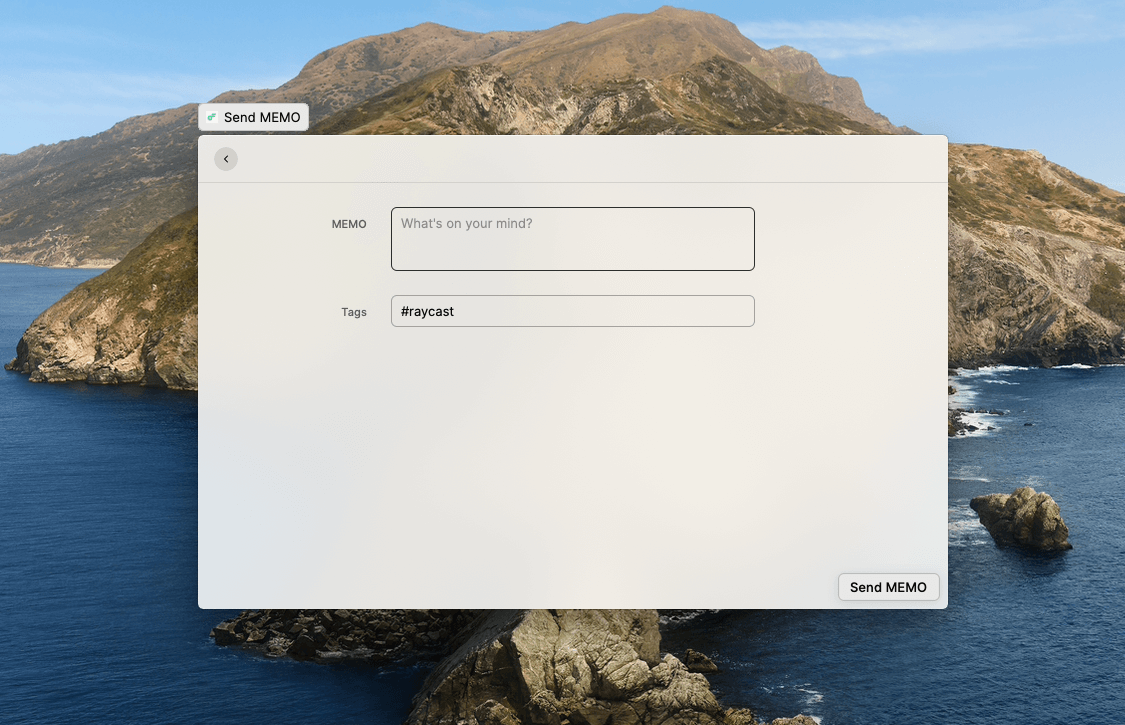
You may input anything to flomo through Raycast.
### Guidelines
#### Installation
Step 1. Install [Raycast](https://www.raycast.com/)
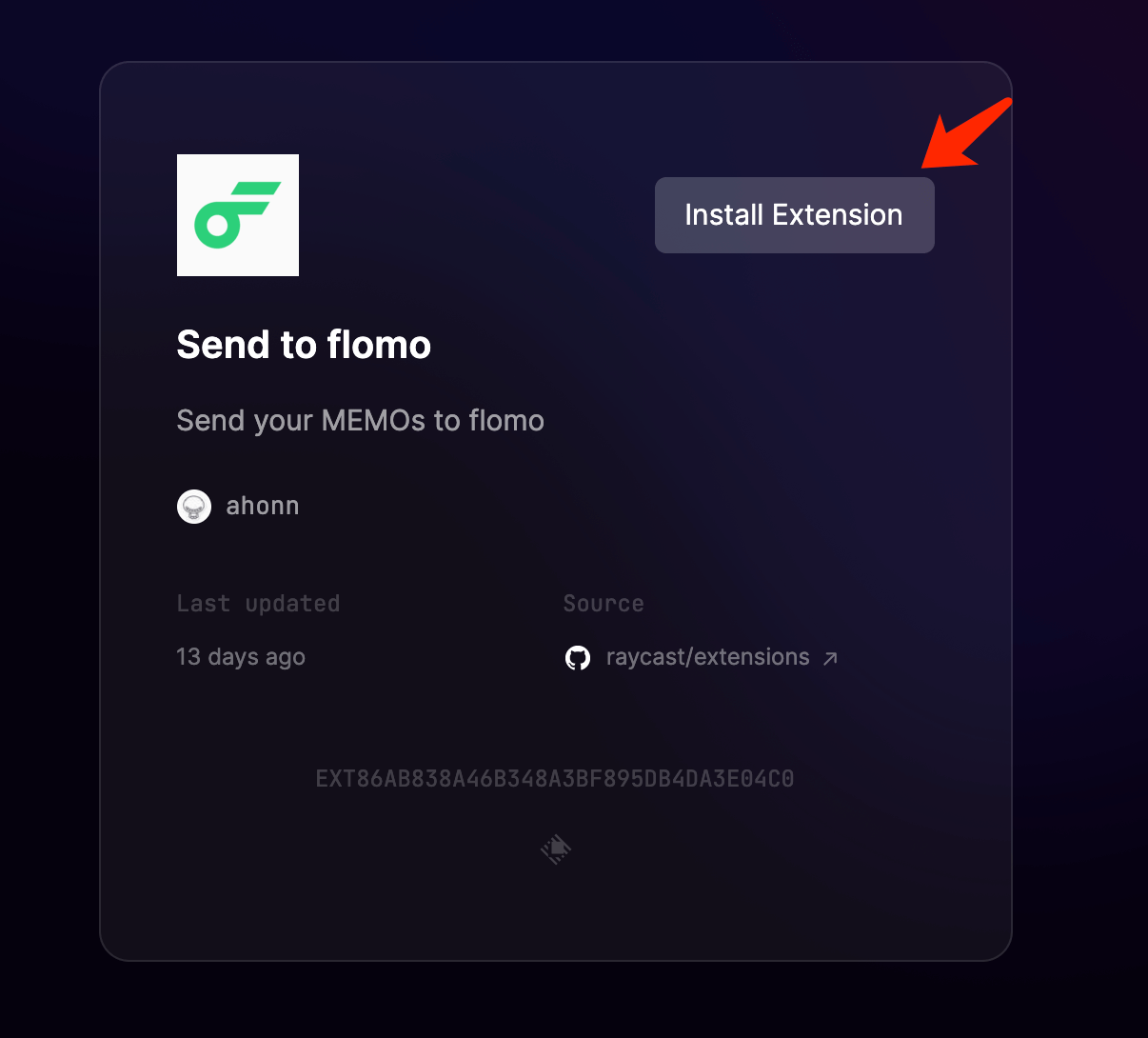
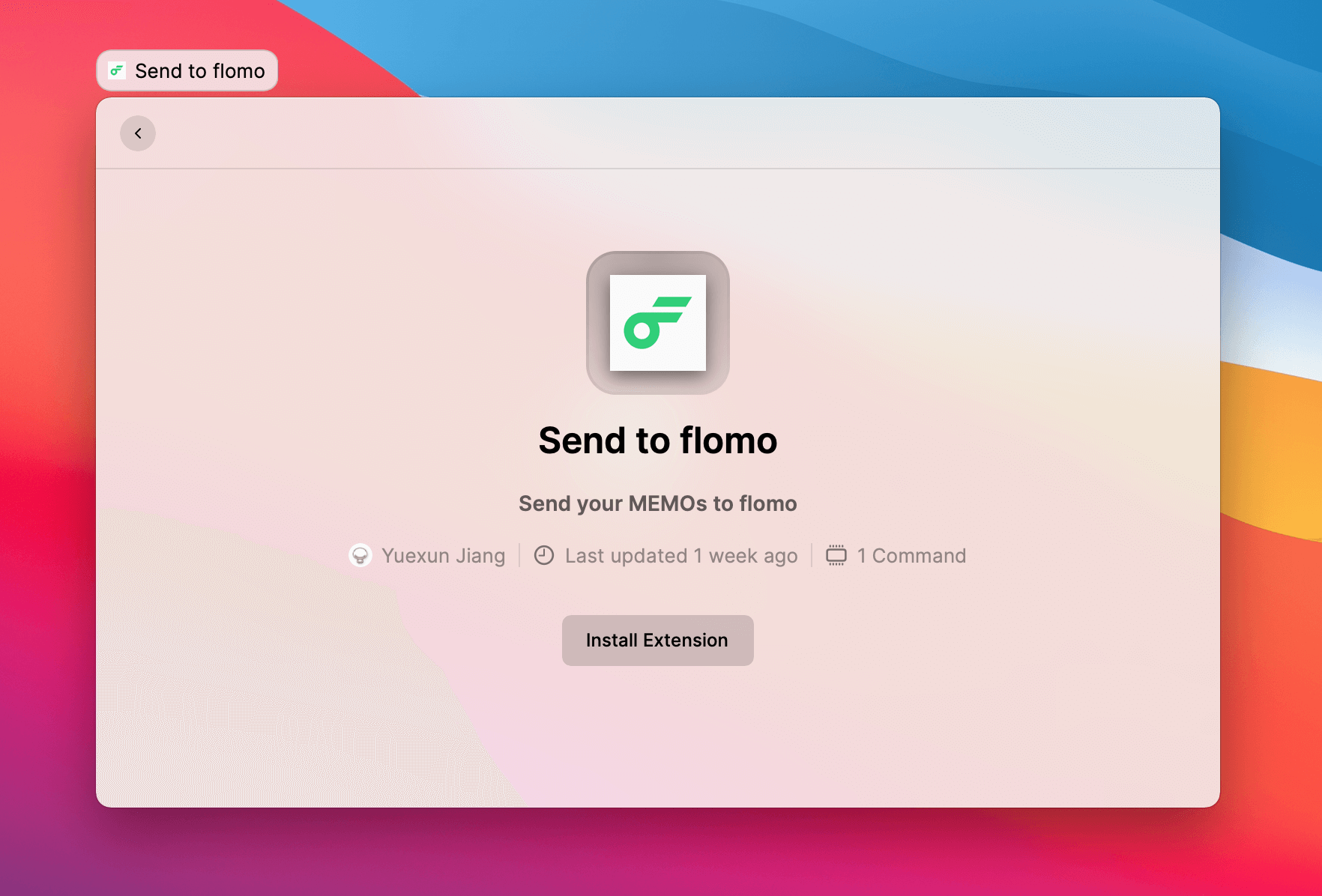
Step 2. After installing the Raycast, click to install flomo extension: [**https://www.raycast.com/ahonn/send-to-flomo**](https://www.raycast.com/ahonn/send-to-flomo)**(opens new window)**
#### Configuration
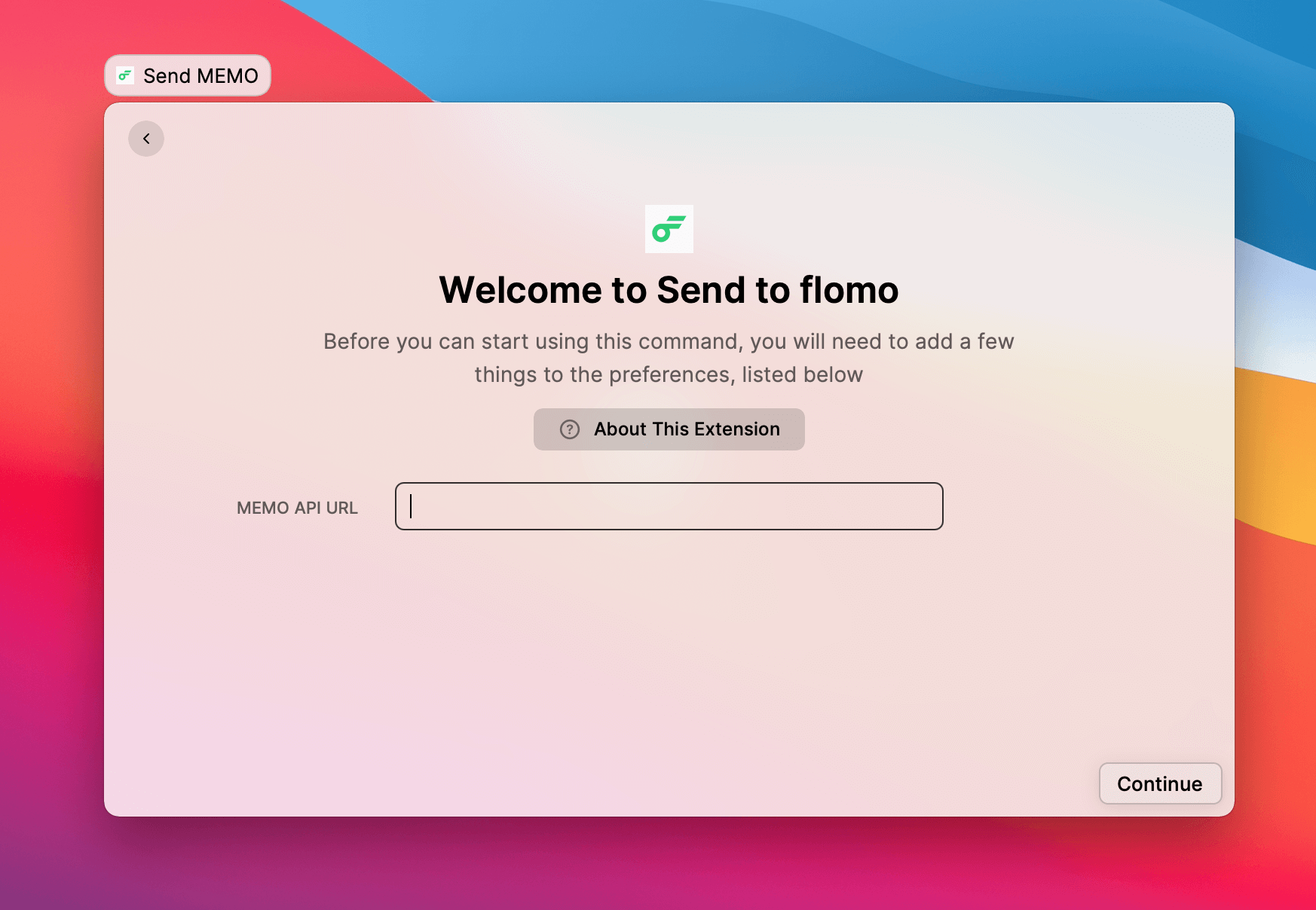
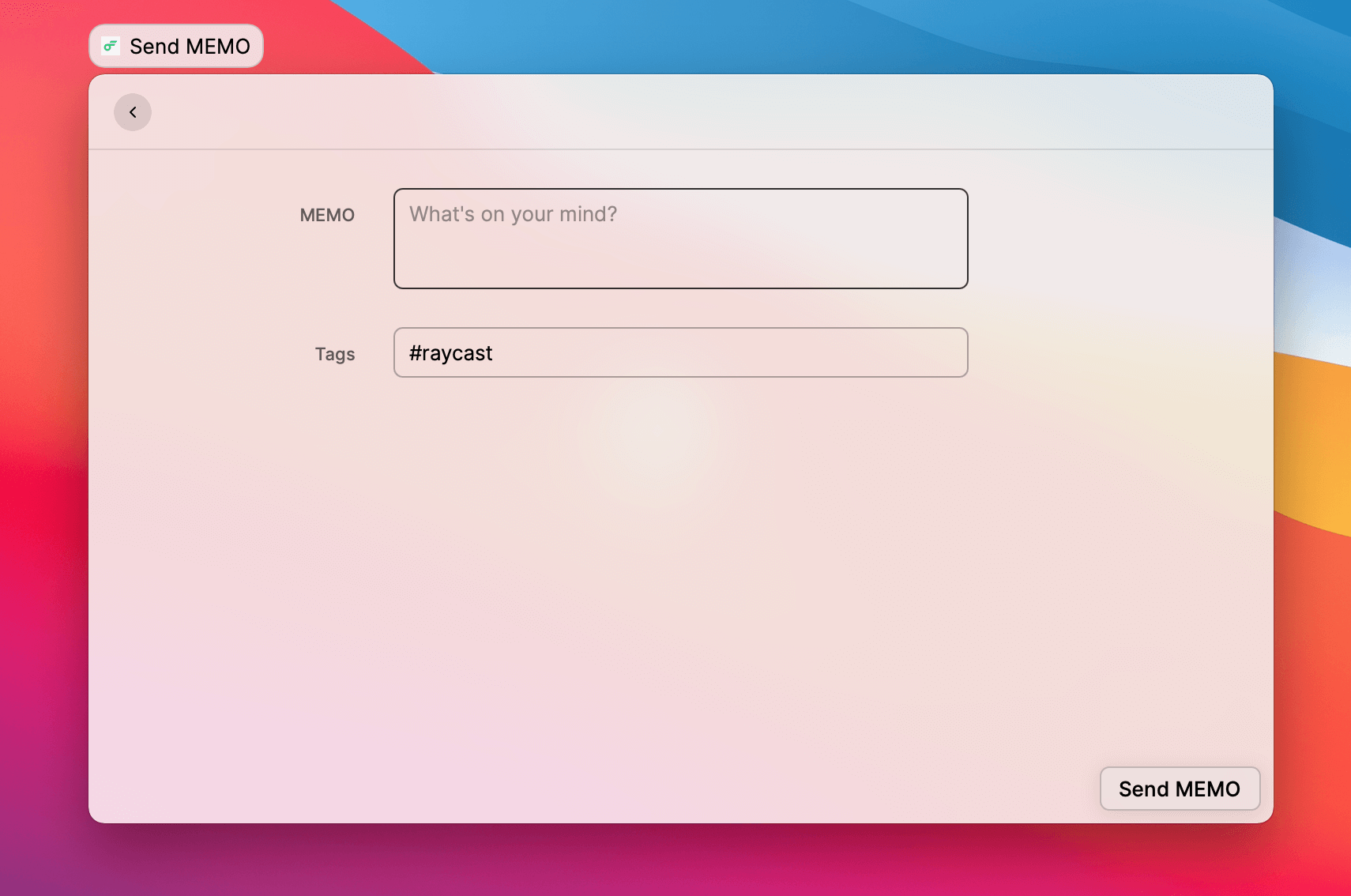
After installing the flomo extension, click the Open Send MEMO, and then input your flomo API (If you don’t know your API, check [here](https://flomoapp.com/mine?source=incoming_webhook))

#### Usage
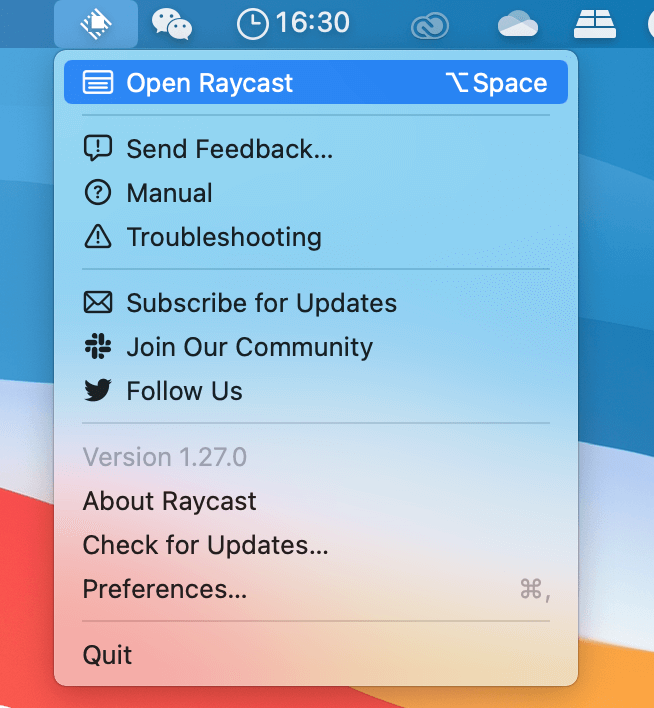
Open Raycast and choose Send to flomo. Now you can input any ideas and tags to flomo.
# Drafts for flomo
made by geekdada with ❤

[**Drafts**](https://getdrafts.com/): Where Text Starts
## Extension description
* Add the entire draft to flomo.
* Adding #Drafts by default for sorting.
* Obtain the tag from a draft and add it to the end of the text.
Download :[ https://actions.getdrafts.com/a/1fS](https://actions.getdrafts.com/a/1fS)
## Install
Prerequisites: Drafts installed
* After opening drafts, click [install](https://actions.getdrafts.com/a/1fS) in the plugin address
* Click \[Open Drafts] in the pop-up window
* In the pop-up window in Drafts, click \[Basic] and add successfully!
## How to use
* On a draft document, right click, and in the list of actions that appears, click \[Run Action].
* Search for \[flomo], click \[send to flomo], and you're done!
# Start here

Stepping into this new digital era of note-taking and productivity, many of us may get lost in the ocean of wonderful tools but find nothing to be written down. Some people may even jump from one tool to another and finally land on the paper notes.
The truth is that tools are supposed to make our thinking easier rather than add more barriers. If we are not sure how to use tools, then we somehow become the slave of tools.
That's why we create this flomo College. The goal behind it is not to encourage you to use flomo more often, but to teach you mindsets of knowledge management so that you can choose and use your tools wisely.
We expect that one day when you graduate from flomo College, you learn a new way of thinking, and finally find a better self.
Marshall McLuhan once said: "We shape our tools and then our tools shape us." May flomo and this College luckily be the tools that once shaped you.
[The Myths about Note-taking](/mindset/the-myths-about-note-taking)
[What Knowledge Should be Accumulated?](/mindset/what-knowledge-should-be-accumulated)
[The Definition of Knowledge and Its Management](/mindset/the-definition-of-knowledge-and-its-management)
[Why Should We Use Cards for Note-taking](/mindset/why-should-we-use-cards-for-note-taking)
[How to Organize Your Tags with I.A.R.P](/mindset/how-to-organize-your-tags-with-i.a.r.p)
[Why Is Adding to Favorites Useless?](/mindset/why-is-adding-to-favorites-useless)
[Is There a Perfect Category?](/mindset/is-there-a-perfect-category)
# The Myths about Note-taking
Here we would not provide you with “the best note-taking method”. Instead, we encourage you to build your own way. Those productive experts may tell you how to write better articles about productivity rather than how to build a real production system based on your own workflow.
Those who truly create note-taking methods never mentioned the method itself. They paid attention to effectively researching through the methods. Take Luhman as an example. He seldom write articles about Zettelkasten but shared a few practices when he was ready to retire.
There is rarely a lesson about how to take notes. Even we know a few methods, we may never think of building a system.
So before creating your own stuff, let’s see a few blind spots.
### Productivity tools are useless until you manage the real productivity skills
We are not simply using tools but also improving our workflow through tools. Sometimes it’s not the tools that are hard to use, but our workflow needs to be improved.
Say, there are tons of lessons about playing golf, but there is no lesson about using the golf club. The golf club is the tool, but playing golf is a whole workflow. Only learning to use the golf club can’t make us an outstanding golfer as Tiger Woods, let alone the only used a second golf club.
So, rather than learn to use tools, pay attention to the productive goal you want and the suitable way to achieve it. There are too many people who get lost in searching for the best tools.
Focus on the goal and methods rather than the tools. When you have these two, you will know which tool is the best for you.
### Writing is not a result of thinking but a medium of thoughts
Even if you have never thought of writing a book, you need to organize your thoughts and the daily information you received.
Writing can improve one’s thinking because it forces you to read, comprehend, and organize information. Reading a lot of books is not equal to a lot of ideas. Wisdom and self-mastery are acquired practices by practices, just like swimming. Therefore, the challenge of writing and studying is not studying itself, but comprehension. When you truly comprehend something, you consciously put it in a structure formed by related thoughts and ideas. In this way, the new knowledge can be quickly remembered and recalled.
When you absorb the information, a specific and practical goal will definitely change the way you deal with it. You will be more curious, more precise, even more critical. You won’t miss any detail, and you will try to perfectly record everything. You will ask a sharper question, and you are no longer satisfied with the blurred logic. You will naturally think about the best place to display your work because the feedback in that place can motivate you to think deeper.
Deliberate practice is the best way to improve everything. When you practice setting a goal for your reading, you are deliberately practicing the most basic skill: thinking. Even if you have never truly published an article, your thinking will be enormously improved.
### Nobody is creating from scratch
The worst blindspot about creativity is “Creation means making new from emptiness”—empty pages, canvas, and stages...The most common literary theme is implying to us that the essence of creativity is new from nothing.
Our typic writing lessons somehow enhance such a belief. We are told to find a topic, which is the very first step to writing something. And then we do some research, discussions, and make a conclusion. But the weird thing is: how you can make a decision about the topic before you find it worthy to be researched? So before you find a topic or a worthy-researched problem, you have to dig into reading. The subject you are going to read is not popping out as well. It usually comes from your existing interests or comprehensions.
And this is the core of creation: you research a topic and accumulate thoughts before you choose a topic to write down. Ideally, you should research it before you write it. Thus you can accumulate materials, references, and thoughts for weeks, months, even years. That’s why so many people buy the idea of building a second brain.
When we are reading, we are building a growing thinking pool. So in creating, we won’t simply follow our instinctive plan in our brain. We will check our notes, and follow our interests and curiosity. These are all inspired by reading, thinking, discussing, and note-taking. There are no more empty pages. There is no need to face the dilemma of nothing to write down.
No one is truly writing from scratch. All the things they are thinking come from their prior experience, research, or other understanding. But because they haven’t acted on this fact, they can’t track ideas back to their origins. They have neither supporting material nor accurate sources. Since they haven’t been taking notes from the start, they either have to start with something completely new (which is risky) or retrace their steps (which is boring).**\[1]**
Taking notes and putting them in your second brain can release you from the traditional linear path of writing. It allows you to systematically summarize information from the linear resources, reorganize them until a new pattern emerges, and then turn them back into linear texts for others to read.
You will find the changes in making this shift when the fear of not enough to write about is replaced by the problem of having far too much to write about.
### Knowledge assets will be more valuable than the financial assets
We all call ourselves “corporate slaves”, but it can be divided into two types:
* Traditional employees who rely on the tools of production belong to capitalists, such as delivery guys (requires orders and navigation) and workers in the factory (requires large machinery).
* Knowledge employees who produce the ultimate value though they rely on the tools of production as well, such as a doctor to explain the image of MRI.
Most people of the previous generation are traditional employees. But most of us are knowledge employees. Such a change means that knowledge has become our tool of production. When we resign from a company, it doesn’t mean we have nothing left. The accumulated knowledge is our tool of production (even materials of production). We can make a living by summarizing our previous experience into a book or a lesson, or we can pass the following interviews by abstracting the experiences into a structure.
The environment of big companies today is no longer as colorful as they were ten years ago, and some of us feel “involution”. It is because those who worked in the past were knowledge employees, and they were creating many tools of production. But those who are feeling involution have become traditional employees because of the standardization of jobs. You may compare those who created the search ads and those who are working on optimizing the search ads now.
What about the future? In the future, maybe the knowledge assets will be more valuable than the financial assets.
So it doesn’t matter if you are going to use [flomo](https://flomoapp.com), but the first thing you need to do is to build your own knowledge base in any way.
#### Reference:
1.
# What Knowledge Should be Accumulated?
I have seen many questions like these: “what knowledge should I accumulate?”, “I love cooking, so should I take notes about recipes?”, “I am going to run a marathon, so should I take notes about preparations?”, or “I love reading. Need I to take notes about my favorite sentences?”
If we only react to a single point, an article, or a book rather than build a area , then we may lead to chaos, which can’t be solved by any advanced techniques. Nor bidirectional links or AI.
### 1. Area: your long-term responsibility
According to Wikipedia, area means the coverage of a range of professions and things. Or we may translate it into “the motif of our lives”.
But it is still blurred.
Take me as an example. When I started working for several years, I happened to organize all the areas I was interested in. It surprised me that there was such a wide range I was curious about. Maybe I spent a lot of time learning these areas, but since there were a lot of areas as well, the time I spent on each area could not make me be professional.

Among these areas, I followed some because of my greedy curiosity, while some were my interests and short-term projects. I was interested in physics and mathematics, but I didn’t need to apply them in my daily tasks. As for the recruitment and cooperation, they were projects with precise deadlines and goals. I didn’t need to go further in these two areas.
Areas, interests, and projects are three concepts that are easy to be mixed up. I would like to try to differentiate them here:
Interests are something you are willing to spend time on without any returns. If you stop learning, it won’t do any bad to you. Why was I interested in physics? Because at that time I was inspired by Elon Musk’s first principle. But if I stop learning physics, it won’t influence my other tasks.
Projects are something with a precise beginning, a deadline, and a goal. Because I needed to finish the interviews of summer interns in a short time, I spent some time learning the recruitment and interviews. The interviews had standard criteria. All I needed to do was to remember and follow them.
Areas are something without a precise deadline and a quantified goal. But if you screw it up, you need to be responsible for it. Take [flomo](https://flomoapp.com) as an example. I need to think about the future of thinking tools as long as flomo exists. I have no idea about the end of this exploration and I could not stop learning. Once I stopped learning and flomo was out of date, then I am the person who need to take responsibility.
Keeping fit is another example. It is a area because you are responsible for your health. But the daily practices including running or something else are projects. We make progress in this area through various projects. While the pilates you are fond of recently is an interest. Because it won’t influence the whole area if you stop.
We keep making progress project by project. Some interests may transfer to be areas and some areas may be left behind as time changes.
* Areas without any projects can hardly make you refined.
* Projects without areas can sometimes get you lost.
### 2. Choices about areas: should you learn everything?
About ten years ago, I was working in a company with Lightory (co-founder of flomo). He was going to resign and start his own business. I persuaded him: “This company is great. Though there is nothing to be learned in area A here, you can choose to learn B.” But Lightory asked me a question that I could not forget forever. He asked:” why should I?”
“Why should I learn this?” Why was I astonished at this simple question? Because for years I am taught and required to “learn diligently” and “knowledge is never a burden”, which caused my cravings for learning everything without distinguishing whether I need them and whether I am good at it. Until that moment, I realized that I had the choice to not learn something and to give up some areas.
Set your course by the stars, not by the lights of passing ships. —— Omar Bradley
The area each person needs to learn is not isolated but intertwined. Each person may be good at different areas, and these areas may add up or disappear as time changes. So I may draw some premature conclusions here:
* As human beings, we have to learn many areas and be responsible for them.
* Each person may choose different areas to learn. One man's wilderness is another man's theme park.
* Areas change as time and place change. Such learning is not once and for all.
Everyone lives a different life. There is not a common rule that everyone must follow. So forget about those words like “you need to get married at the age of 20”, “you will meet the middle-age crisis at the age of 30”, or “you will be unsuccessful at the age of 40”. Instead, if you still want to make any contributions to the world, it is vital to choose your own areas. It is time to stop and ask yourself: who you wanna be (rather than others want you to be), and start from here.
I felt so insecure around 2016 because I found I was not professional at any of those areas. So I made a decision to give up the exploration in coding, design, and management. Instead, I focused on the arae of service design. Back at that time, I believed that the full-process service would be important in the future. Think about it: if the takeaway you order could not serve you on time, can a better user experience of the app make up for it? So perhaps the future requirement to a product manager is to make users feel the same online and offline.
Since then, you could see the areas I learned have changed.

Why not spend some time counting all the areas you are in? Inspect them like inspect the investment moves and ask yourself: what returns do they make?
And then think about your future investing tactic: which areas need to be bought in and which sold out? Do you want to spread risks round or to all in?
Just remember, the big difference between time and money is that you can never deposit the time.
And no one can help you to make the “right” choice about areas.
### 3. Refine in areas: take real and concrete actions
Have you ever read the book *Stories of the Sahara* written by Sanmao? Were you interested in living in the desert after reading that? I was. But the first time when I rode a camel and walked on a sand dune, I only felt overwhelmed: a wobbly giant camel, and a vast desert. Anyway, it is beyond words. If you have never been to a desert, you would not understand the feeling of living in a desert.
What I’m trying to say here is that real knowledge is not the words in books but the thoughts, ideas, experiences, or something you gain after practice. If your flomo is full of web clipper: others’ opinions or undigested articles, then the map you are grabbing is not yours, and your brain is the playground of others’ thoughts. The shortcut is always the longest way. So you need to record and think honestly. This is the basic requirement for making progress in areas.

Besides the record, we also need to see the fruits of our progress.
If we buy stocks, we can see the changes easily in our account. If we raise children, we can see the differences in their ages and personalities.
But how can we know the result of our investment in areas?
The MEMOs of flomo is to quantify your knowledge (Well, you can choose any tools to practice deliberately. I just take my love flomo as an example). The statistics, the recording days, and the MEMOs you accumulated are your investment in some areas.
And then, when you are going to export something, you will feel the results brought by your investment.
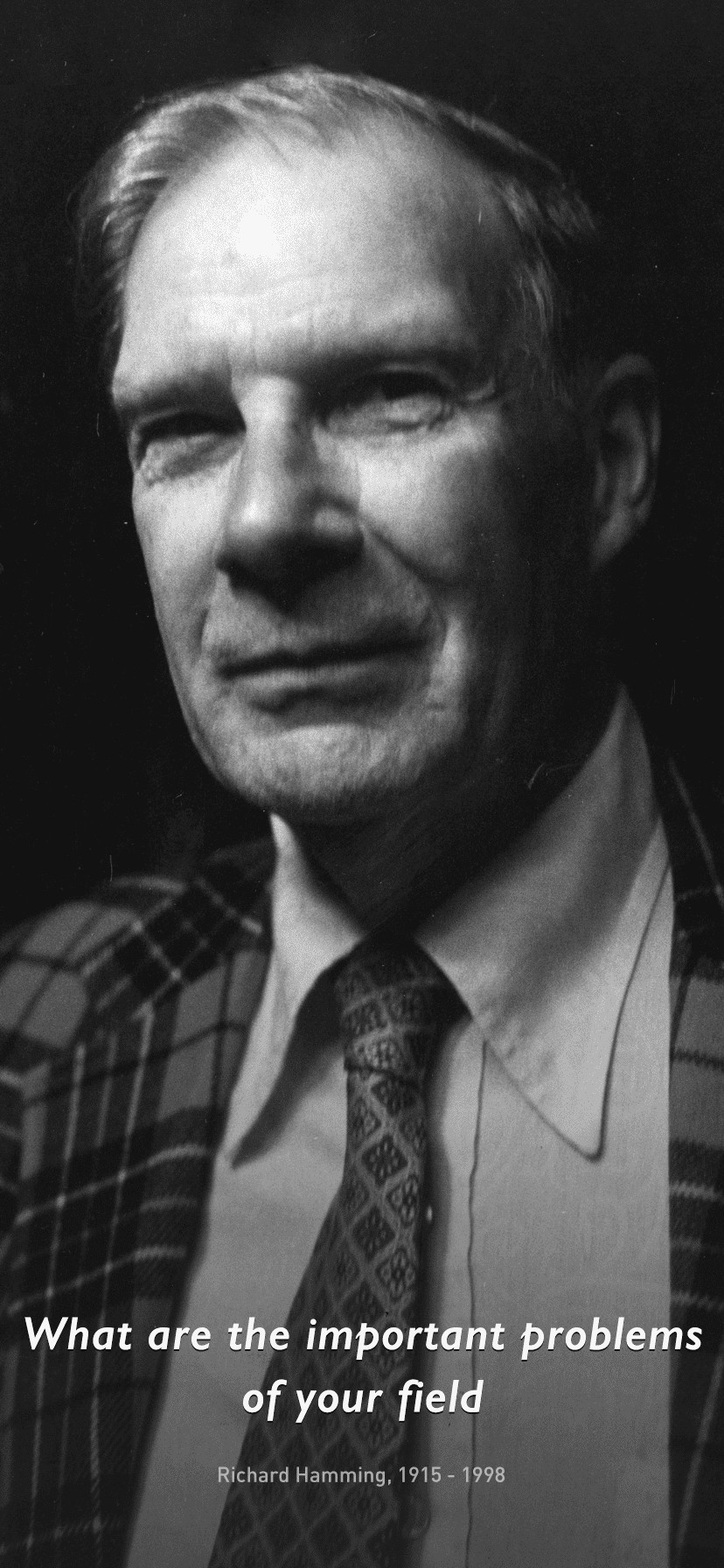
Here I’m going to share a wallpaper with you so you can re-read the famous pun from Richard Hamming, the Turing Award winner and inventor of Hamming code:
What are the important problems of your area? Are you working on one of them?
### **References**
`[1]` Richard Hamming:
# The Definition of Knowledge and Its Management
### What is knowledge?
According to the *World Development Report 1988* released by World Bank, knowledge is defined as the information for production.
While in *Managing for Results* (1964), Drucker described knowledge as “But knowledge is a specifically human resource. It is not found in books. Books contain information; whereas knowledge is the ability to apply information to specific work and performance”.
### The characteristics of knowledge (hard to be managed)
1. Knowledge somehow represents power and advantage. People are not always willing to share all their knowledge and experience. A proper scheme is needed to inspire them.
2. Knowledge is fluid. The inner staff in an organization may move, while the individuals may forget it.
3. Knowledge is fragmented. It needs to be upgraded from time to time.
4. The value and interests of Knowledge can’t be valued quickly.
### What is knowledge management?
The classic one-line definition of Knowledge Management was offered up by Tom Davenport early on (Davenport, 1994): “Knowledge Management is the process of capturing, distributing, and effectively using knowledge.”
Or knowledge management is a system that can transfer the captured information into knowledge. It can generally and continuously collect explicit and tacit information and then transform it into the business culture or individual brands. This system allows people to focus on the exchange of information. Through the interactive, the value of knowledge can be re-created.
What is more important:
* Collect high-quality information including the hidden knowledge, and be aware of the information addict
* Transfer knowledge effectively
* Build a standard system (e.g. Zettelkasten method)
* Connect the dots and inspire new knowledge.
### The meaning of knowledge management
Peter Drucker predicted in 1965 that knowledge would become the most important factor of production instead of the land, labor, capital, and machinery. He believed that in the 21st century’s organization, the most valuable asset is the knowledge employees and their productivity.
In this information age, knowledge has become the principal source of wealth, while the knowledge employees are the most vigorous assets. The first task of organizations and individuals is to manage the knowledge. Proper knowledge management will make the organizations and individuals more competitive and better at making decisions.
Currently, the science of management focuses on the knowledge work in the level of incorporates and managers rather than the level of individuals. Although most of the work today is knowledge-driven, the core of management is still the managers and incorporates. Individuals are always not that important.
But with the improvements of infrastructure and the growth of the content creator economy, we may spend less time in one organization but live for a longer time. Most of us need knowledge management, which means investing in knowledge to accumulate compound interests.
Andrew Hunt once suggested that to manage knowledge in the way of managing portfolios.**\[1]**
1. Invest it regularly: To form a habit of learning.
2. Diversification matters in the long-term investment: Focus on the present as well as the range of focus.
3. Manage the risk: Never put all the eggs in one basket but also remember to prevent low risk and low return.
4. Always manage to buy low and sell high: Learn some new emerging techniques.
5. Evaluate and balance your investment periodically: Evaluate the knowledge that deserves to be concerned.
### The classification of knowledge
#### According to the adaptability
According to Drucker’s *Post-capitalist Society*, he divided knowledge into:
* General knowledge means the wisdom which is cultivating nurtured moral human beings.
* Specialized knowledge means the information in action that can be proven to be effective for the outcome of the action, mainly in work, study, work analysis, and work management.
Say, if you are on a desert island, you may probably wish to be accompanied by \*\*Bear Grylls rather than Confucius and Socrates. The latter may have general knowledge but the former can solve the problem of basic demands on a desert island. Because of the difference in general knowledge and specialized knowledge, this new society could be built after the industrial revolution.
#### According to the qualities of knowledge
* Knowledge of facts: know what. It is about historical facts, experiences, and statistics.
* Knowledge of principles: know why. It is about the principle and rules which usually belongs to science.
* Knowledge of skills: know how. It is about the crafts, skills, and abilities which usually belong to the techniques.
* Knowledge of human: know who. It is about who knows what and who knows how. It includes some specific social relationships and social divisions. It usually belongs to experience and judgment.
#### According to the form of knowledge
* Explicit Knowledge: Also known as coding knowledge, it refers to knowledge that can be expressed in language, words, numbers, and so on. It can be easily communicated and shared, and it can be presented in the form of documents, manuals, reports, maps, etc.
* Tacit Knowledge: Also called uncoded knowledge, it refers to knowledge that is difficult to express, highly personalized, and difficult to be communicated and shared, such as the experience, know-how, and intuition of operators or employees.
* Skill-based tacit: informal, hard-to-express skills, techniques, experience, and know-how.
* Cognitive tacit: insights, intuition, perceptions, values, mental models, and team’s rapport, understanding and organizational culture.
### Reference:
*
# Why Should We Use Cards for Note-taking
### What is Zettelkasten
Zettelkasten, perhaps some of you are very familiar with it. It is a German word equal to slip-box in English.
Essentially, Zettelkasten is a process rather than a tip. It is a method of stashing and organizing knowledge, expanding our memory, and generating new ideas. Or we can say, it encourages you to collect all the knowledge you need and process it in a standardized way. After connecting the dots among notes, you may know how to use them.
As a tool, Zettelkasten is a box (or a set of boxes) for index cards or memos. There is a piece of information, an index, and a source of information on each memo. Normally, these memos should be as short as a few words or sentences. The cards should not be large, so they can be simple and neat. Pictures and other forms also work.
But the point is you should write down in your own words rather than copy information. When you read new information from other resources, you should process it in your own way. Don’t worry that your understanding is not precise because you can put all the metadata including the source on the cards.
The core idea here is to keep permanent notes for your future. Write down immediately; write down in a clear and simple way as if you are going to show somebody else. Regard the process of writing a wiki. You may lack skills but are full of resources and indexes.
Of course, the whole process of Zettelkasten requires practice and patience. When the cards are accumulated, you will have an incredibly large knowledge base.
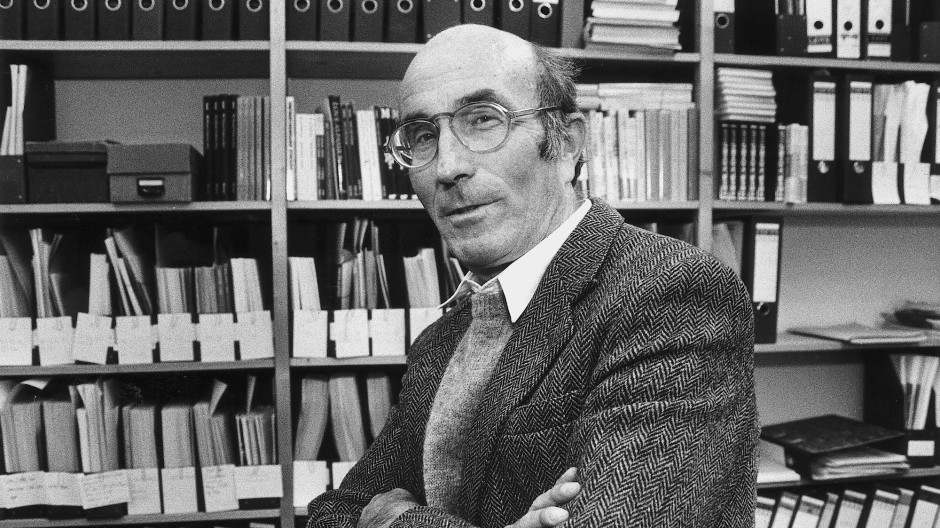
Luhmann used this method to accumulate 90,000 knowledge cards and wrote 60 books and numerous other publications in his lifetime. In 1968, when Luhmann published his thesis at the new university, he received a questionnaire about the content of his research. His answer was this: ”**Project: Sociological Theory. Duration: 30 years. Cost: Zero .“**[**\[1\]**](https://blog.karthisoftek.com/a?ID=01700-041199e4-093b-4a51-8a54-dc32be643092)
### The principles behind the cards
“Chunk” is a technical word in psychology, which means the knowledge unit you are very familiar with and can search in your memory index. Since it exists in the index, the chunks are anything you can think about in the professional area.
For example, each English speaker has stored more than 100,000 chunks, which are called “words”. When we read some words in a passage, we search for their meanings in our memory.
The idea of chunks comes from a dissertation named *What We Know About Learning* by Herbert A. Simon.
While in Nicolas Luhmann’s opinion, the cards advocated in his Zettelkasten are similar to the chunks.
So, while learning, we don’t grasp the whole knowledge system once and for all. Instead, we accumulate knowledge points or chunks or cards, whatever, gradually.
The difference between a professional and a nonprofessional is the chunks they have. A professional may have 50,000 to 100,000 chunks of knowledge.
Although a card is simple, it can build a complex structure through cards by cards. All the complex structure comes from the accumulation of the smallest unit. Think about the ants, the bees, the cities. So does the palace of knowledge.
### The structure of a card
Let’s see the structure of Luhmann’s cards.
* **Unique identifier** gives your cards a specific address. In [flomo](https://flomoapp.com), the unique identifier is the time stamp.
* **Body** is where you write down the parts of knowledge. In flomo, it is the body of MEMO.
* **References** allow you to write down the source of knowledge. If thoughts belong to yourself, then you can leave out the references. In flomo, annotating a MEMO is inspired by references.

The body of a card is vital. That’s why flomo doesn’t support excerpts or import API. **Because the heart of the Zettelkasten is using your own words to record everything rather than copy and paste. Copy-and-paste only makes you a carrier of knowledge rather than a rebuilder.**
Compared with recording a lot of content at once, a few atomic cards may help you more. That’s why I insist that the input field should be as simple as possible.
### What to record on a card?
While using the Zettelkasten, adding MEMOs without thinking will reduce the quality. Besides the quality, the quantity is also needed to witness a quality leap. There are three types of notes:
* **Fleeting notes** are the reminder of information. You just jot down a few words, and later they might be dumped or be archived to be permanent notes.
* **Project notes** only relate to a specific project.
* **Permanent notes** will never be dumped. They have the necessary information, and they exist in a permanent and understandable way. Permanent notes are the result of processing the above two types of notes.

### Suggestions on writing cards
Not all of us will become writers or publish dissertations. But all of us need to record and think.
The value of writing MEMOs (cards) rather than articles is to facilitate our thinking. No one is creating from scratch. They always need accumulation.
So here I would like to give you some suggestions on writing MEMOs (credit to Yang Zhiping):
* While writing a card, **do not think of posting it to social media**. Posting cards will increase your cognitive load. All you need to do is to write down instead of increasing your social assets.
* You should **write down “counter common sense”, “names”, and “terms”** on cards. “Counter common sense” is used to expand your cognitive boundaries. “Names” is used to memorize the creator of knowledge. “Terms” are used to memorize the source of knowledge.
* It is recommended to **write three cards every day at least**, and nine cards the best. But don’t write too many cards because it is hard to remember them all the next day.
More importantly, **making progress through small actions and a long period can last longer than impulse efforts.**
### The benefits
Many times, when we are faced with a blank editor with a flashing cursor, we try to dig out our minds with something completely new, and after a few minutes, we realize that it is in vain. As time passes we will tell ourselves, "It seems that we don’t have that much creativity.”
But the truth is nobody is creating from scratch.
Anything new must come from previous experiences, research, or insights.
As knowledge workers, we shall know the rule is that researches and accumulations always come first. In other words, we should do some research before writing down anything. Then we will have weeks even months of accumulated materials for reference.
That’s why we created flomo.
Because most of the other note-taking tools are like a blank canvas encouraging you to paint on it. But flomo would like to be your knowledge database that integrates all your thoughts, observations, research, and ideas.
Many of us don’t have such a habit of accumulating ideas. So when we are going to write down something, it’s hard to find the resources. That’s the reason why we sometimes fail in writing. Since they haven’t been taking notes from the start, they either have to start with something completely new (which is risky) or retrace their steps (which is boring). [\[2\]](https://fortelabs.co/blog/how-to-take-smart-notes/) You’ll see the changes brought by a habit when the problem of not having enough to write about is replaced by the problem of having far too much to write about.
### Reference:
\[1]
\[2]
# How to Organize Your Tags with I.A.R.P
Each tag is not born equal. Some tags may become the main trunk(e.g. #marketing, #design), while the others may become the branches (e.g. #MarketingManagement). A few flomoers may be concerned about whether they should use tags as the categories of folders or use tags as content supplements. But tags should work for facilitating our indexing. And who says a MEMO can only contain one tag? The core of adding tags is not to create a perfect category but to find the MEMO we need.

So after introducing these two types of tags (there are many more, but I won’t go into them), I would like to introduce a method of using tags as Navigation. It is inspired by the P.A.R.A from Tiago Forte. But in [flomo](https://flomoapp.com), I choose to index the content with a simpler way of I.A.R.P.
The information is digested by individuals, added tags to build connections, and then becomes knowledge. So each person may differentiate in his or her customized tagging system. So there is no perfect plan. There only exists YOUR plan.
I.A.R.P goes for a set of acronyms, that is:
* Inbox: I put all the temporary, undigested content here. I archive, organize, or delete them regularly. It can be seen as a cache of information for your brain when you are not sure where to put them.
* **Area:** An area is important because you need to make progress in this area. For example, keeping fit is an area, while running is a project which belongs to this area. Writing is an area while writing a blog is a project.
* **Resource**: It can be regarded as the permanent notes in Luhmann’s Zettelkasten method. Normally, it contains all the digested content in your interests, topics, or assets rather than the content clipper.
* **Project**: It means a forthcoming event which you can’t finish at one time. For example, writing a book can be a project. You need to collect materials, make outlines, and write passages. Similar projects can be organizing a trip, or recording an episode of the podcast.
The hardest part is Area, which means you have to know what areas you are concerned about most. Our lives are chained with a series of events. For most of us, we don’t have a precise list of our projects in life and work. But we may feel like we are burdened with tons of projects. After years of working busy, we may find we have done many things but not been professional at anything. That is the problem caused by only focusing on projects. Well, you can check [here](https://help.flomo.app/mindset/what-knowledge-should-be-accumulated) to have a better understanding of the area.
The following is a screenshot of my pinned tags. You may see a few adjustments.
* Inbox is my information cache for my brain.
* Area contains all the areas I am concerned about. I regularly organize them, of course.
* Project includes a few relevant materials about ongoing projects.
* Weekly is my most important project.
* ESL is my most-concerned area.
* GreatMinds is the most important resource.

Except the pinned tags, most tags don’t work as navigation but as supplements for MEMO. So even there are hundreds of tags, I won’t feel hard to organize them.
This is only a personal usage of tags. I wrote down this article only in order to share a new perspective.
If you have some ideas to share, please join our [discord](https://discord.com/invite/z2wHUKjab2) here.
# Why Is Adding to Favorites Useless?
We are easy to fall into the trap of Favorite Paradox——Feeling that adding to favorites means learning. But actually learning something is not the same as knowing something. Adding to favorites is similar to transferring the information (rather than processing it). You don’t add anything new to it.
You don’t have to capture 100% information. Our brains are like filters. Your subconsciousness is defaulted to filter all the “useless” information. You need to constantly change the filter so as to input the information into your brain.
The information is collected by your senses. It is not the essence of everything in the world, but the part of our perception to those things. So while absorbing information, recording is also a process of explaining, which can write the message into your brain.
### Why are we fond of hoarding information?
A few reasons why we become the digital hamster:
* It is an emotional compensation. Hoarding information can compensate the past self, while to-do can build a better self.
* It is functional support; it is actually piling up the digital materials.
* If classified according to the time, these digital materials can be divided into the collection of existing concrete memories (such as photos, files, and recordings), and the collection of unhappened abstract plans (such as to-do lists, wish lists, etc.).
* The media has changed;
* While uploading the content that needs to be remembered and preserved, “the function of media is changing from the information producing center to the information memorizing center”.
* The platform is luring you to become a digital hamster through improving the storage and way of spreading memory.
And these are the pros and cons of becoming a digital hamster:
* The environment is pushing you to memorize and express.
* Obsession with collecting may make us focus on the expression rather than the present moment.
* It is easier to forget because the information can be retrieved anytime via the devices.
### Are you recording information or knowledge?
How to differentiate these two? Well, information can often be summarized with one sentence. And information is “dead” or fixed. For example, “I talked with Alex” is a lifeless fact.
You should process the information and gain a few ideas. If you add any related content in your notes and connect the dots in them, this may generate great value even if you are not using the knowledge you created.
### Feel troubled? But it is the desirable difficulty.
Recording in your own words can help you in memory. This conclusion is from the cognitive psychologists Mr. and Mrs. Bjork. About thirty years ago, they put down the theory of desirable difficulty.
They first differentiate two types of memory competition: storage strength and retrieval strength. People used to believe that the faster a person remembers the better he studies. In short, the easier to store the faster to retrieve. But their experiment showed a different conclusion, which is that storage has a negative relation with retrieval. It means that the easier to store the harder to retrieve. Instead, if you feel hard to remember something, it will be more convenient for you to retrieve knowledge.
Just as that proverb: The palest ink is better than the best memory.
### Only record that most touching information.
According to *How to Effectively Organize Information*, the most important material to record is not the “materials for producing knowledge” but “something really touched you” (what a perspective!). The former may make trash of favorite materials. But the latter may become the important message that constantly inspires you.
Similar ideas are mentioned in *Why Students Don’t Like School*.
The information that really touches you can be easier to remember. So instead of recording answers, it will be more effective to record questions. Because questions mean conflicts. Conflicts bring emotional fluctuation, which pushes you to move forward.
For example, we mentioned three types of materials worthy to be recorded in [*Why We Should Use Cards for Note-taking*](https://help.flomo.app/mindset/why-should-we-use-cards-for-note-taking), that is, “counter common sense”, “names”, and “terms”. “Counter common sense” is used to expand your cognitive boundaries. “Names” is used to memorize the creator of knowledge. “Terms” are used to memorize the source of knowledge.
### Record your own voice.
The core of recording is to record your own voice. Because nobody can tell you your ideas. Only those materials that touched you can become the heart of knowledge production.
Taking notes is paying tribute to your own thoughts. Thinking is similar to taking pictures. Quantity brings quality. If you don’t keep practicing, you can hardly output anything valuable.
We are easy to fall into the trap of Favorite Paradox——Feeling that adding to favorites means learning. But actually learning something is not the same as knowing something. Adding to favorites is similar to transferring the information (rather than processing it). You don’t add anything new to it.
You don’t have to capture 100% information. Our brains are like filters. Your subconsciousness is defaulted to filter all the “useless” information. You need to constantly change the filter so as to input the information into your brain.
The information is collected by your senses. It is not the essence of everything in the world, but the part of our perception to those things. So while absorbing information, recording is also a process of explaining, which can write the message into your brain.

### Change your way of collecting.
The best way to use [flomo](https://flomoapp.com) is not to throw a link in it or collect the entire article. You can mark the content your need first and then summarize it. Or after reading, you can re-write your understanding on flomo.
Be honest with yourself and pay efforts.
Taking notes in this way may not be easy, but don’t forget that the knowledge has a strong compounding effect. Those who seriously take notes will be distinguished from those who don’t.
[Tiago Forte](https://fortelabs.co/) (we may mention him several times) is a famous master of knowledge management. He mentioned seven principles of gaining knowledge, which may be relevant to this article. Let me share with you
1. Interaction over consumption: put your time and efforts into note-taking rather than simply collecting.
2. Balancing details and discoverability: don’t be too detailed or too simple.
3. Choose to compress knowledge: take notes about those that really matter to you.
4. Instinct over analysis: we don’t have a refined thinking pattern.
5. Focus on the most valuable information: it doesn’t matter if you only remember one sentence in a book.
6. Tacit knowledge over explicit knowledge: your special opinions can never be taken.
7. Focus on questions rather than answers: the quality of a question is the foundation of a solution.
# Is There a Perfect Category?
A few flomoers may ask: How should I categorize all my MEMOs? How should I use tags? But these are not the real question. The real question is how we should organize information.
### Using folders is a traditional mindset
From the Library of Alexandria to Wikipedia, there are two important topics in knowledge management, which are, store and organize.
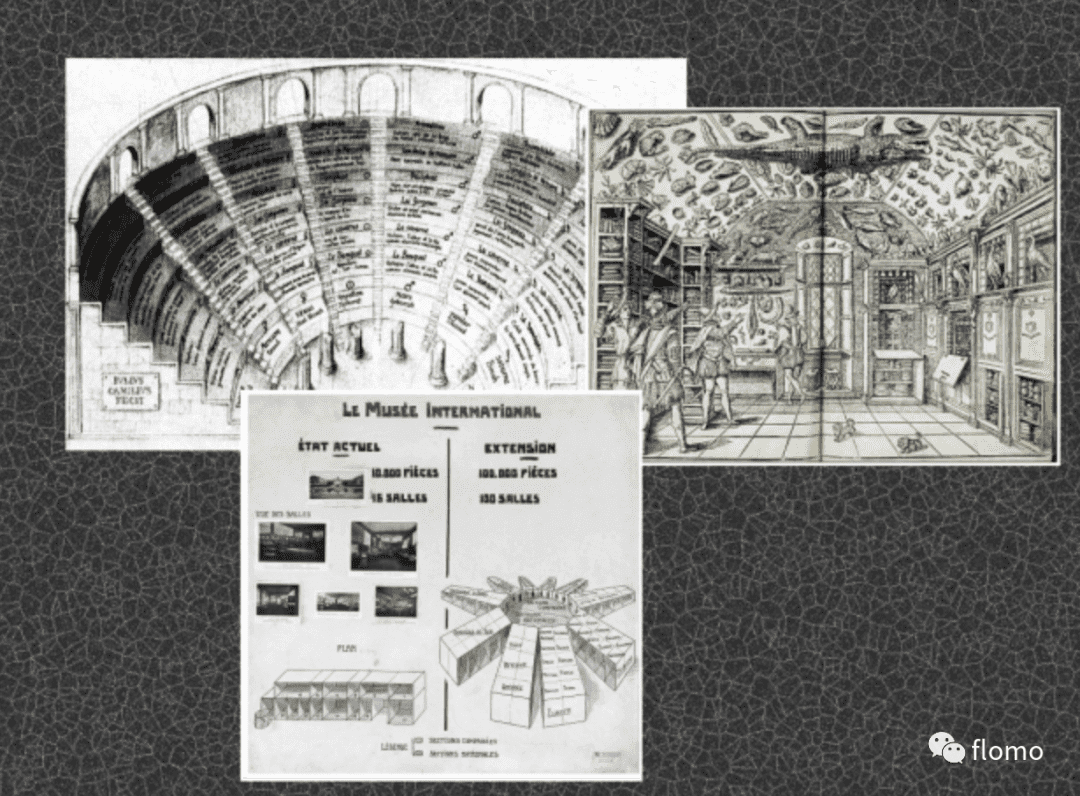
When we organize the knowledge, we have many choices. But most of the note-taking tools follow the organizing rule of folders, which means a knowledge unit is saved to a certain folder in a specific route. When a project is related to a lot of other things, you can use tags. But each file is usually saved in one hierarchy. If a user wants to use the file, he or she must remember the folder route or use the search to locate it.
But when you collect information, you will quickly find that a file can be connected with a lot of questions.
If you collect information in a folder, you may find that it’s hard to connect them all together. The information without contexts may be forgotten in some solitary corner.
More importantly, each article has knowledge chunks, which connect with a few others in your thinking pattern. This will put you into a dilemma as well. If an article is connected with three areas you are currently working on, then should you put copies of it into every area folder? If you do, then each time when you modify this article, your efforts need to triple.
### A structure grows itself
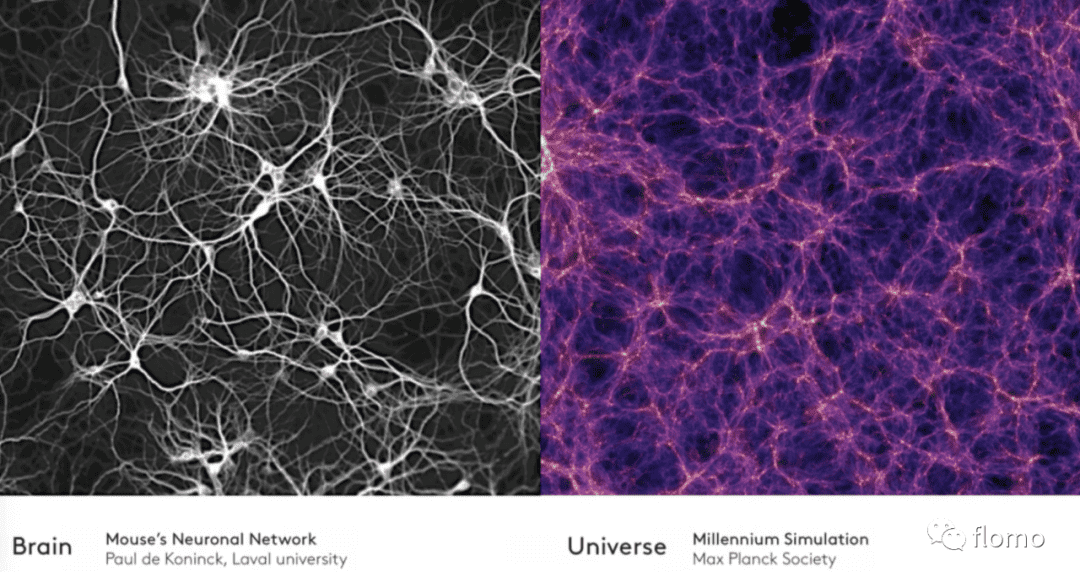
On the left is our neuron cells, while on the right is the stimulated universe we already knew. It seems that there is a rare “well-structured” category at both macro and micro levels in nature. The picture looks like a network built by nodes and connections. The important nodes are expanding. Many nodes will build more connections based on your accumulation.
Luhman had realized this fact very early. He repeatedly emphasized that creating a category is a top-down process. You start by building the structure and then categorizing files. But our brains don’t work in the category. When knowledge adds up, the network of things we knew will grow naturally. It’s not a scaffold but a plant.

For example, when I learned knowledge about trading platforms, much of it will not unfold as in the following picture. Instead, much knowledge will come to me randomly.

* The first knowledge chunk is “value unit” which comes from an article about the methodology of Booking. I didn’t pay much attention to it after taking notes.
* The second knowledge chunk is a book named *Code Version 2.0*. It has no connection with the trading platform (at least I thought it didn’t).
* The third knowledge chunk is the “core elements of trading platforms”. After learning it, I realized that the first knowledge chunk could be put in this category. While the second chunk is at the same level as the third chunk.
* Based on the third chunk, I learned the fourth chunk in the relevant book *Platform Revolution*.
* Based on the second chunk, I dug out the fifth chunk in *Code Version 2.0*.
Though this mind map looks organized, the learning process is hardly similar. It can’t be possible to learn in this way. This structure grew itself.
Laura, one of [flomo](https://flomoapp.com) users, had ever told a story about “the structure of knowledge grows itself”:
There is a reason why we prefer the “systematic”. It brings us a sense of safety and a sense of grasping the knowledge. When we were at school, our teachers would teach us to “systematically” learn something. In the library or Wikipedia, the documents are formed in a systematic way. So when we manage our own knowledge, we would like to use a similar organized method to categorize it. But such categories are built based on the knowledge that already exists in an area. For example, if a textbook author is a master in a certain area, he may write a textbook based on a framework because his knowledge of the area gives him the ability to build a system. As a learner, the way you manage your knowledge is naturally different from the way a textbook is compiled by a master. You may collect a few chunks here, and some chunks there. Later, you may form the network of this area. I remember when I was a kid, my teacher called the excerpt notebook “collecting honey”. If we are learning knowledge from different areas, we need to actively connect the dots. These are something that we don't expect when we try to build a “system”.
Categories are like buildings. Once built, it may encounter the problem of re-building. While absorbing knowledge is more like the process of neural circuits being enhanced or decreased. After continuous collection, the structure will grow itself. So it is meaningless and impossible to build a precise category from scratch unless you stop growing.
### Is organizing a goal or a path?
A good system never costs you lots of effort to organize. If you need to organize a system regularly, then it is contrary to the goal of a system. Because except wasting time, organizing notes could provide nothing else.
A better method is allowing your system to grow naturally with the changes in your knowledge. More importantly, you should use questions to motivate you to explore areas. Through deliberate practices, you then earn some compound interests in a certain area.
Organizing is a path rather than a goal. The real goal is to find our progress in a certain area.
# Why Does Knowledge Need to be Connected
### The ways of connection

If you have ever played the SimCity, you will understand that the development of cities highly relies on the way of connections.
* If there is no highway, then people will quit their job because of the shitty commute.
* If there are all roads and no streets, people will complain about no any chatty space.
* If there is no connection at all, the whole city will be stuck.
When you are heading off to a place in a hurry, you may consider driving on a highway or trying the subway. But when you want to leisurely wander around a city, the highway is definitely not a good choice.
The connections (traffic) in a city somehow define what the city is.
### The connections in our brain
The knowledge stored in our brain is in the way of an organized library but an expanding city with skyscrapers, parks, and slum areas, all connected with roads and streets.
Searching for some knowledge points is like transporting on highway. You can’t reach any place other than the destination you are about to go to. But adding tags is more like the roads. Though it has both effectiveness and accuracy, you can hardly reach two places directly through roads.
There are similar ideas in an article on the Zettelkasten method: “search queries are deterministic means to get to Zettel notes: they produce the same results every time. Links are hand-picked references. The idea that makes you create a link is unique, and so is the resulting link. It’s much more personal and thus better suited to help you think.”\[1]
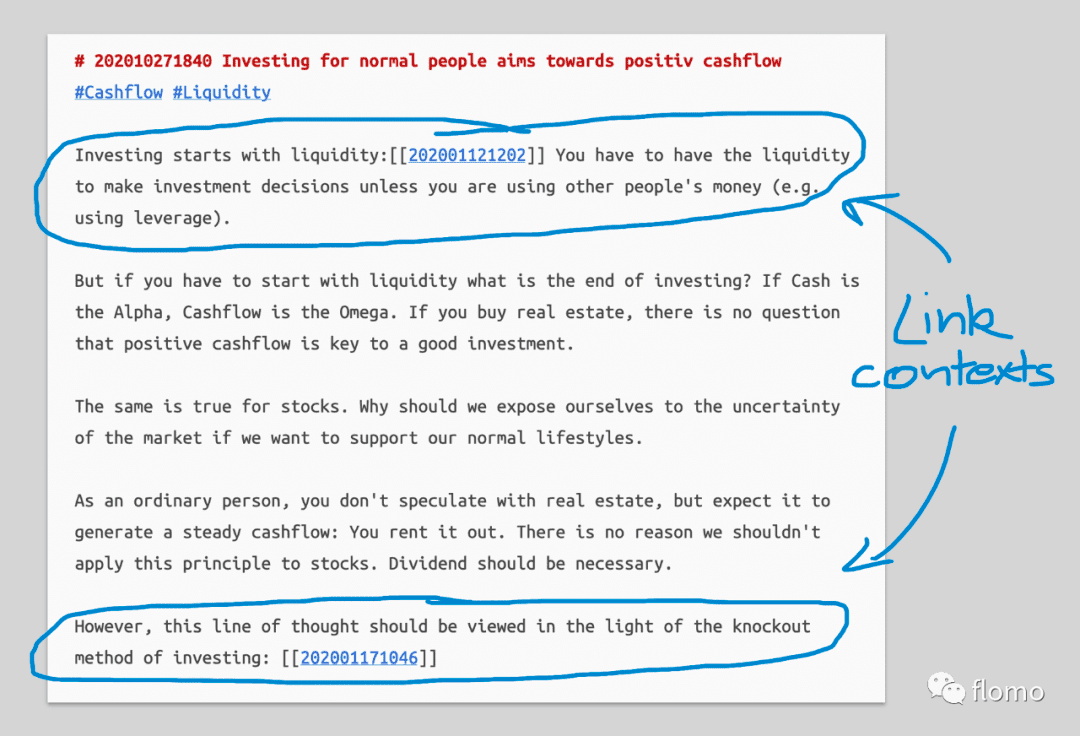
Manually linking a card to another can enhance the connection between notes. You may annotate the link to remind you of the context. Therefore, these links will only be meaningful to you. It is your second brain, and that’s why it is here.
[flomo](https://flomoapp.com) supports not only searching and tags but also annotation, so now you can build some avenues among your MEMOs.
### Case study
For example, I jotted down some MEMOs about knowledge management and put it under the tag of #KnowledgeManagement.
And some characteristics of the knowledge reminded me of a MEMO about seeing knowledge from the perspective of investment. I somehow felt there was a connection between them, and this investment MEMO is put under the tag of #Investment and #Technology.
After reviewing this MEMO, I recalled a conversation of compound interest with a friend Meng. There were some falsities about compound interest. Say, making 1% progress each day can bring a big difference. But not so many people can have such a speed of iteration. Well, the tag for this MEMO is #Friend/Meng #Investment/CompoundInterest.
So based on this connection, I talked about the falsities of compound interest in a course to prevent you from desires while taking notes. Some of our users felt it was interesting to see the accumulation of notes from a perspective of investment.

As abovementioned, these three MEMOs were put under different tags. So if using search or tag search, they can hardly appear together. But if I add a new tag to them, then there will be too many tags to search as well.
So the simplest way is to annotate them, just like building a street connecting them all. In this way, when I check one MEMO, I can easily think of the others. In the history of science, there is many new knowledge coming from such an intersection.
More streets are built, then more new knowledge can be created. Then we can see the value brought by compound interests of knowledge.

### So how to use Annotate?
#### 1. If you already had two MEMOs connected

After finishing these two steps, the MEMO you copy the link from will also add a backlink. So you can easily find them together whichever you choose. But whether it is useful depends on the change of your thinking.
#### If you want to annotate a new MEMO to an old one
If you want to annotate a new MEMO to an old one, you can choose the “Annotate” in the MEMO menu. Then a link is popping up on the input box. So you can add some thoughts and save it.

#### [**#**](https://help.flomoapp.com/thinking/link.html#references)**References**
`[1]` An introduction of Zettelkasten: [https://zettelkasten.de/posts/search-alone-is-not-enough/](https://zettelkasten.de/posts/search-alone-is-not-enough/*)
# What is the Meaning of Review?
The feature mentioned: [Daily Review](https://help.flomo.app/advanced/daily-review)
## [#](https://help.flomoapp.com/thinking/how-to-review.html#%E5%9B%9E%E9%A1%BE%E4%B8%8E%E8%AE%B0%E5%BF%86%E7%9A%84%E5%85%B3%E7%B3%BB)The relation between review and memory
Hoarding things is like the nature of humans. No matter what it is, food or information, human beings are tending to hoard it. It is the gene flowing in our blood. However, memory is a voluntary action. We need to make efforts to remember things.
The ability of memory is the core of a person. It can be divided into two types:
* **The memory of the Past:** things that happened in the past, e.g. what lesson we have learned.
* **The memory of the Future:** things are going to happen, e.g. who we are going to meet tomorrow.
While Memory of Past includes:
* **Implicit memory:** the memory of skills, e.g. brushing teeth
* **Declarative memory or explicit memory:** the memory of facts and meanings, or the memory of events
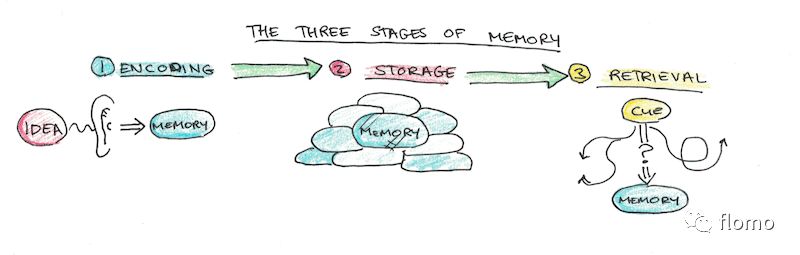
Okay, quick quiz time. Picture the logo of Apple Inc. in your mind. Can you describe it exactly? Why is it not easy to draw it correctly? Because though we see it often, we are not familiar with its coding. The process of memory is:
* **Encode:** input information to our brain
* **Storage:** save information in our brain
* **Retrieval:** extract appropriate information when necessary
So when we store the information without proper encoding, we may find slight differences while retrieving it. If we want to have better memory, we need to improve these three abilities.
**How to better store information?**
* Have enough sleep: a longer nap can lead to the sleep stage of consolidating memories
* Practice and review regularly: the **Daily Review** of [flomo](https://flomoapp.com/) is designed according to this rule
**How to better retrieve information?**
* Associational memory: use association to build connections among information
* Proper anticipation: predict the information needed
* Deliberate practice: recall the connections regularly to deepen the memory
## [#](https://help.flomoapp.com/thinking/how-to-review.html#%E5%9B%9E%E9%A1%BE%E5%86%B3%E7%AD%96) How to improve decision-making ability?
Set a tag about decisions, and write down a simple but clear decision-making process under it. By setting the range of this tag, you can review the scenario of each decision, and annotate the decision-making process with the knowledge you have today. In this way, you can improve your decision-making ability.
Here I’d like to recommend to you a book named *Decision-making Mindset* written by Jialing Wang. In this book, the decision is defined as “Decision is a series of decisions which have long-term impacts and a series of resources allocation towards one goal”. So making a decision is not an impulse but a scientific process, and you can improve it by deliberate practice.
Besides a specific goal, there are another two premises in order to improve decision-making ability:
* Write down your decision-making process. If you don’t, you can hardly review it in the future.
* Review your decision-making process regularly. If you don’t, then the recording means nothing.
Take me as an example. At that time, I was undergoing the product design of a community. I met a certain problem that is the traditional Bulletin Board System is not flexible. I wrote down a few thoughts at that time. But as we have mentioned, the premise of making a decision is to collect enough information. So I waited for days and then tried to override these thoughts from another perspective. I kept asking myself “what if I don’t do these?”
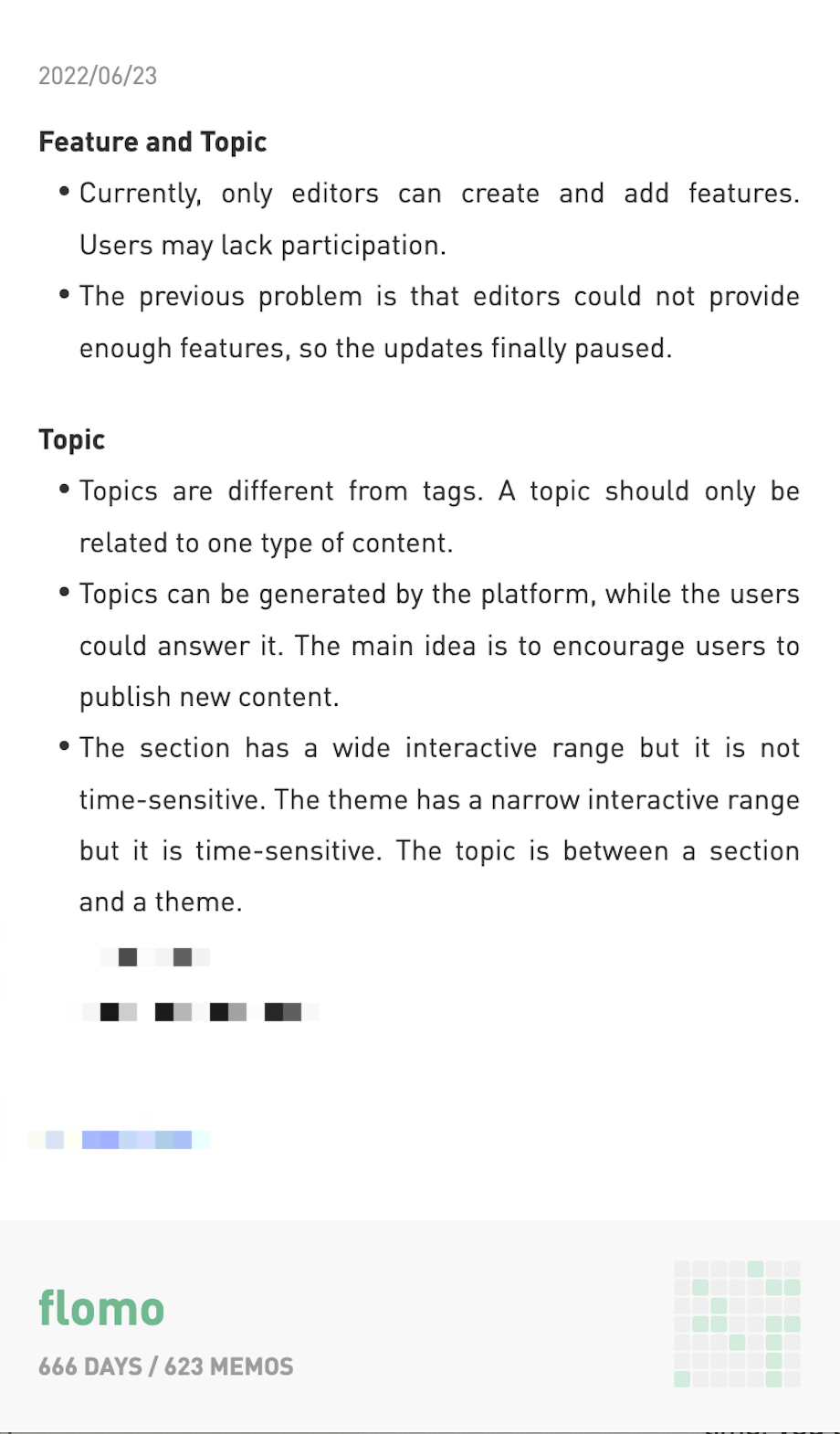
After this design was onboarded, I didn’t see the anticipated result. So I reviewed my decision-making process recorded at that time, and I found a few points I overlooked. But without these records and reviews, constantly adding features will lead to rubbish. It is also true in our life.
## [#](https://help.flomoapp.com/thinking/how-to-review.html#%E5%9B%9E%E9%A1%BE%E6%83%85%E7%BB%AA)How to review your emotions?
Ecstacy depends on one or two exciting moments, while happiness depends on a series of small things. By recording the small things making you happy and reviewing them from time to time, you can improve your happiness and avoid the vicious circle of emotions.
In the book *Mindfulness: A practical guide to finding peace in a frantic world*, it is said that sometimes we are so busy that we make decisions unconsciously, just like an autopilot vehicle on the highway. We say yes to something without thinking; we feel furious about something without any rational control. We are flooded by the noise of thoughts. It seems like we have made decisions, but those are impulses without any thinking.
I have been troubled by such a reaction for some time. But I didn’t know it until a friend of mine reminded me of being emotional. I suddenly realized how aggressive I was. I found one MEMO from the Daily Review of flomo the other day. Now I don’t know whether laugh or cry. Why did I become so sensitive, anxious, and pessimistic?
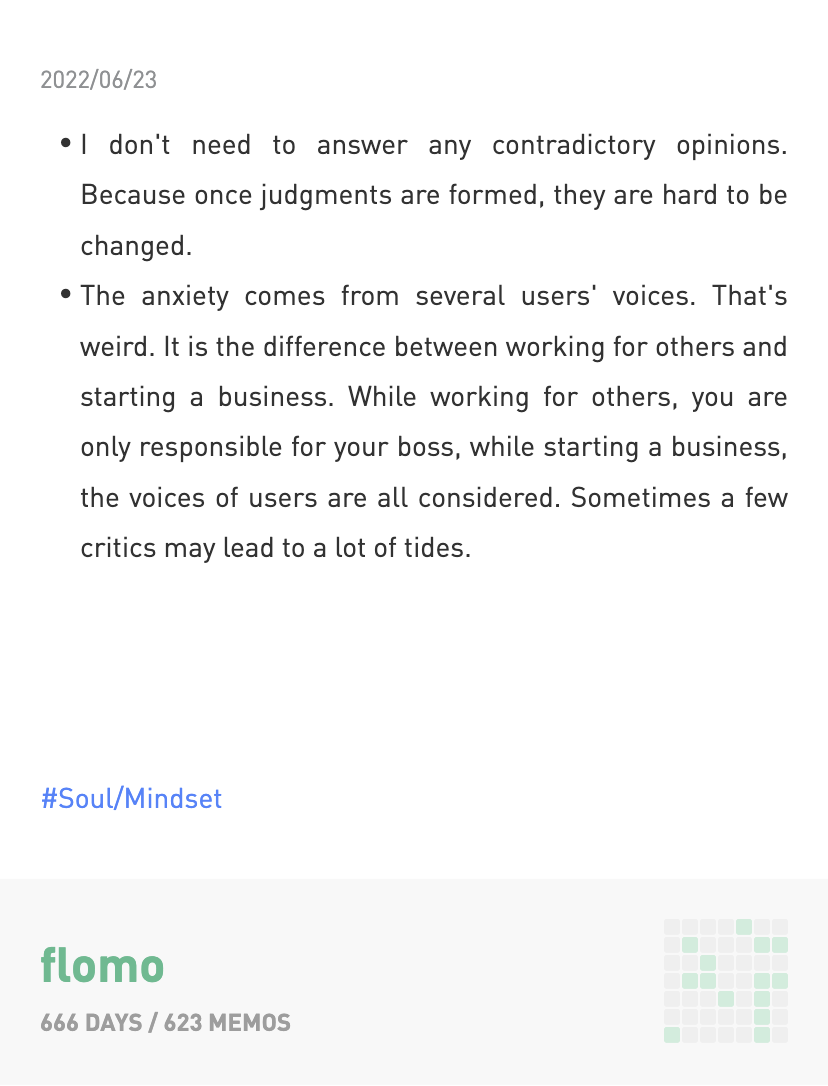
If you are also troubled by emotions, you can record emotions and relevant thoughts on flomo when you are aware of them. It doesn’t have to be negative thoughts or emotions. You can record everything. I have a tag named #Soul/Happiness. Then you can set a rule of Daily Review, and then when you are reviewing these MEMOs, you will know how much you have grown or changed. You may also understand more about who you are, and who you are willing to be.
By constantly reviewing and facing the tides of emotions, you will reach the land of peace with all your efforts.
# How to Take Reading Notes
Think about a question: why do we take reading notes?
We have mentioned before that besides writing, making a decision is also a kind of outputting information. So when we are taking reading notes, adding new knowledge blocks and connections should be our top priority. Writing a reading review with thousands of likes, complicated mindmaps, or fancy visual notes should not be the goal we pursue.
Taking notes is for better thinking rather than showing off.
### [**#**](https://help.flomoapp.com/thinking/reading.html#%E5%81%9A%E7%AC%94%E8%AE%B0-%E6%98%AF%E4%B8%BA%E4%BA%86%E6%9B%B4%E5%A5%BD%E5%9C%B0%E7%90%86%E8%A7%A3)**Taking notes for better thinking**
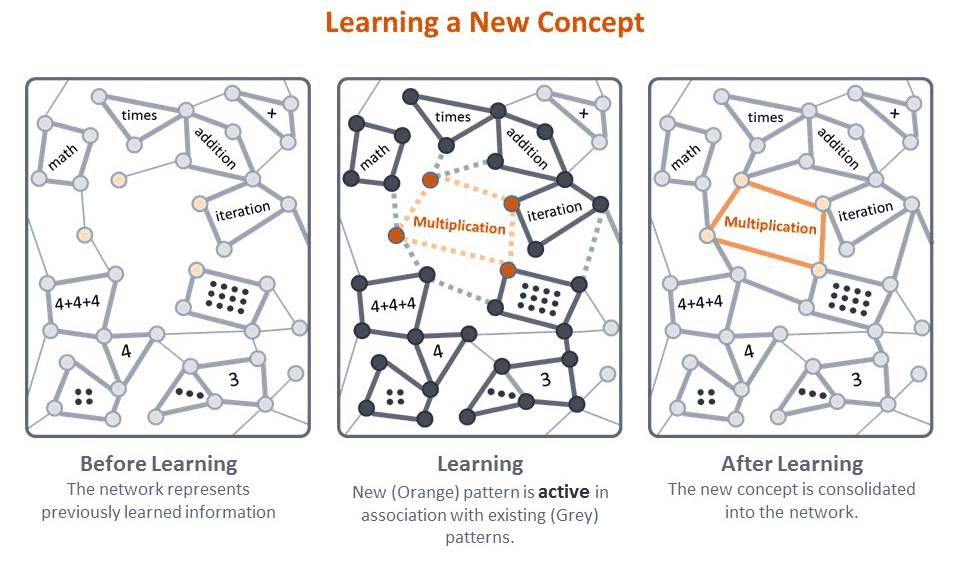
via [**Understanding 'Understanding'(opens new window)**](https://sites.google.com/view/efratfurst/understanding-understanding)
We always say that there is knowledge in books. This is not true. For example, *Probabilities and Statistics for Engineers* only means information to me. Even though there are lots of quotes, I could hardly understand most of them, which means, I could not transform this information into the knowledge helping me to make decisions. Therefore, from this perspective, we should not focus on the quantity of books we read and notes we took, but on:
**What knowledge I have grasped from this book, and what knowledge has connected with my existing knowledge.**
I didn’t like using incentives in product design, so it is hard to find any “check-in for rewards” incentives. But this is out of my personal interests. However, while reading *Why We Do What We Do: Understanding Self-motivation*, the part about rewards shifts my attitude from a rational perspective. It also provides a few solutions on how to give rewards such as “deep linking”, which encourages me to devote myself to building flomo college and our communities.

Linking with our users may not all happen in the product. It can be displayed through the mindset.
### [**#**](https://help.flomoapp.com/thinking/reading.html#%E5%81%9A%E7%AC%94%E8%AE%B0%E7%9A%84%E8%AF%AF%E5%8C%BA)**The mistakes of taking notes**
Before we understand the meaning of taking reading notes, we have taken reading notes for years. Such a habit is formed without any consciousness. But when you review it from another perspective, you may find most of your note-taking efforts are in vain.
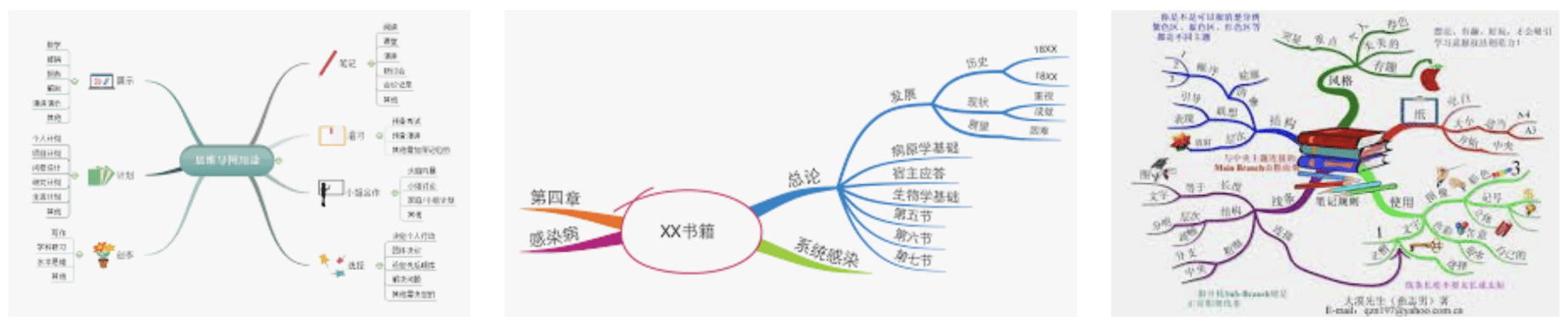
* **Take lots of quotes and excerpts without your own thoughts.** For many of us, reading notes somehow equals a collection of quotes. And the product design encouraging to quote on many reading apps makes it almost frictionless.
* **Pursue all kinds of structures rather than the core of notes.** Many reading notes are just mindmaps with fancy structures. It seems that they are technical. But most of them are just the replicas of contents of books. Their so-called structures remain the same as the books they read. There is nothing of their own in these notes.
* Only categorize the notes with the names of books. The names of books are useless categories. They can only represent that you have read these books. However, the knowledge blocks in books may belong to different areas. So using the book names to categorize notes can hardly allow us to connect the knowledge blocks.
* Keep taking notes without any review. Some people may be obsessed with the quantity of notes and books. They expect to maximize their inputs in a limited time. But in the end, it is the knowledge we could remember that produces values. If we only input information without any review, then it seems that we are saving water from a bucket with a hole. Nothing can be left at all.
Honestly, I don’t want to criticize anyone because I have been there. It is a kindly alert to us to ponder what the meaning of reading notes is.
### [**#**](https://help.flomoapp.com/thinking/reading.html#%E5%A6%82%E4%BD%95%E7%94%A8-flomo-%E5%81%9A%E8%AF%BB%E4%B9%A6%E7%AC%94%E8%AE%B0)**How to take reading notes with flomo**
Say if we are going to draw a picture, instead of getting into the details, we will start from the whole structure first.
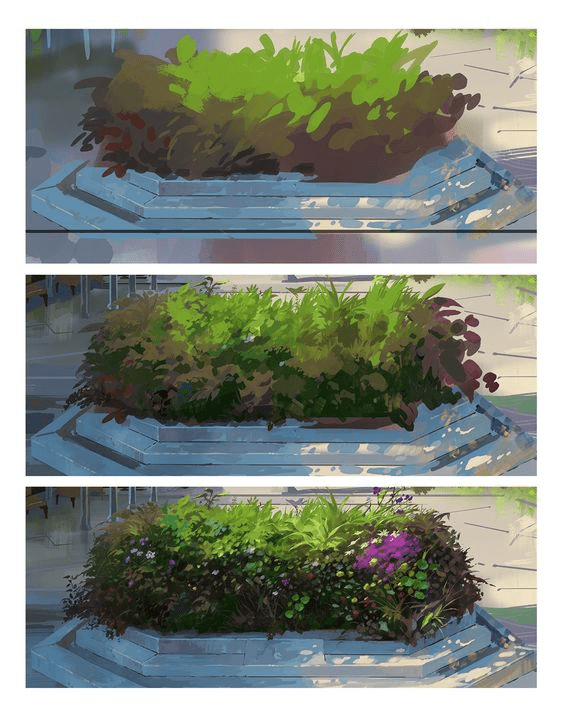
Via [**slowD(opens new window)**](https://twitter.com/slow_haru/status/1092279448794087425?s=12)
It is the same to read a book. When we are going to read a book, we should skip reading it without any notes, and then mark the areas where we don’t fully understand. This is a step in building the structure of the book. Don’t worry about missing out on anything. After finishing the book, if there is one knowledge point being remembered, it is worthwhile.
#### [**#**](https://help.flomoapp.com/thinking/reading.html#%E7%94%A8%E8%87%AA%E5%B7%B1%E7%9A%84%E8%AF%9D%E6%8F%90%E5%8F%96%E5%8D%A1%E7%89%87)**Use your own words to write cards**
As mentioned in *How to Take Smart Notes*, while taking notes, avoid quoting from the books directly. Use your own words to write cards. Don’t worry about your expressions or words. Writing cards is a mirror of your understanding. Be honest with it.
If you are not reading for academic results, you don’t have to distinguish the difference between fleeting notes and permanent notes. I mean, the process is not that important. Make sure you know the goal and then combine the process with your own habits.
The following card is my notes while reading *Hypertext* *and Hyperlinks*. The information is actually spread in several chapters. While according to my understanding, I believe they could be formed in this way. And because I have just finished the documentary *The Pilgrimage of Hsuan Tsang*, so I connected the history of Buddhism with the one of the World Wide Web. This is the benefit of writing cards for yourself. The connection is engraved in your brain, which is the true goal.

Please note that the content on each card should be as simple as possible. Avoid the complicated formatting or hierarchy, so you can review them faster and connect the cards more easily. The smallest unit in our brain is a knowledge chunk, not a knowledge wall.
#### [**#**](https://help.flomoapp.com/thinking/reading.html#%E5%88%A9%E7%94%A8%E6%A0%87%E7%AD%BE%E5%92%8C%E6%89%B9%E6%B3%A8%E6%9D%A5%E5%BB%BA%E7%AB%8B%E7%9F%A5%E8%AF%86%E4%B9%8B%E9%97%B4%E7%9A%84%E5%85%B3%E8%81%94)**Build the connections with tags and annotations**
There are two features in flomo’s tag system. One is that you can add multiple tags to one MEMO. The other is that you can use a hierarchy of tags.
Normally, there are at least two tags in my reading notes:
* One tag is marked as resources #Books/BookName. It is for easily searching the book in the future.
* Another tag is marked as areas #Area/AreaName/SubAreaName. It is used to connect the knowledge chunks.
But I don’t spare to tag my MEMOs. As I have mentioned in [previous articles](https://help.flomo.app/mindset/is-there-a-perfect-category), the knowledge in our brain is connected to build a web. We don’t have to be MECE (mutually exclusive and collectively exhaustive). We won’t organize our necessities in the way of library classification.
Compared with tags, the annotation is more suitable to build the connections between two MEMOs. While taking notes, if you find a connection with another note or recall some specific tags, you can use annotation to build links between these two notes. Therefore, you can keep MEMOs simple (like I said, one MEMO, one knowledge chunk) but connected.
Why do I emphasize connecting with your existing notes? Because this is a way to distinguish memorizing and understanding.
* Memorizing means the ability to recite something. You can recite a poem without fully understanding it by repeating it several times.
* Understanding means the ability to explain an idea or to use it. You can use a poem to describe a suitable situation and explain the metaphors in it.
If we only write down knowledge chunks according to the classification in books, then notes will scatter on flomo. However, connecting your notes means that you build a thread of knowledge, which can help you to build a larger web.
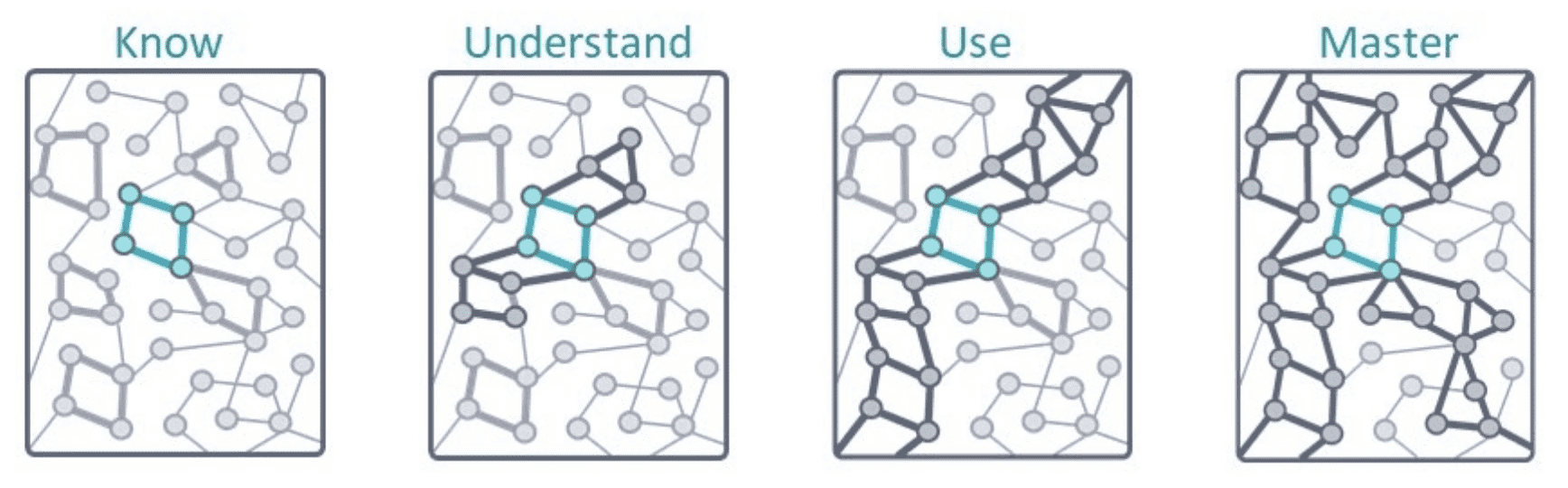
via [**Learning in the brain(opens new window)**](https://sites.google.com/view/efratfurst/learning-in-the-brain)
I have explained the concept of Area in this [article](https://help.flomo.app/mindset/what-knowledge-should-be-accumulated), so I leave out it here.
#### [**#**](https://help.flomoapp.com/thinking/reading.html#%E9%80%89%E6%8B%A9%E4%B8%8D%E5%90%8C%E7%9A%84%E5%9B%9E%E9%A1%BE%E6%96%B9%E5%BC%8F)**Choose different way to review notes**
Have you ever read books but remembered nothing? Have you remembered part of the books but always forgotten? We have seen many similar questions before, and these are why people always saying “reading is useless”. But we are not computers. We can’t remember everything which is plugged into us. So it is important to review notes. It is a way to enhance your memory, and a path to find your growth in knowledge.
There are two types of reviewing on flomo. One is randomly reviewing based on the widgets. Another is regularly reviewing based on WeChat. These two reviewing methods are designed for two different scenarios while reading non-fiction.
* When you are reading textbooks with simple structure but lots of knowledge chunks, it is important to review notes frequently. But it is not that important to remember in a sequence.
* When you are reading books like sociology which requires you to understand it, it is more important to ponder it as a routine.
So as for the first scenario, I personally recommend you to use widgets. Each time you pick up the phone, you can enhance your memory.

As for the second scenario, it is more suitable to use WeChat for reviewing. You can set an alarm to remind you of reviewing these notes. And if possible, you can use annotation to link your current thoughts with previous notes.

#### [**#**](https://help.flomoapp.com/thinking/reading.html#%E7%BB%93%E8%AF%AD)**Conclusion**
What shapes us is not the quantity of books we read, but the understanding we left.
We read books to grasp knowledge. But knowledge is more than remembering. We need to understand what we read as well. Knowledge and understanding are two different parts of the same thing. Knowledge is the collection of the concepts in our brain, while understanding is the connection among these concepts. Knowledge and understanding are mutually reliable.
So when we are taking reading notes, don’t worry about the formatting, outputting, or missing out on anything.
Because taking notes is for better thinking.
# How to Record Your Emotions
Speaking of Diary, do you have such a stereotype that diary is only kept by children or those with profuse emotions? Or do you think that diary is only a way of showing off on social platforms?
These stereotypes somehow blur the true meaning of this word. As we grow up, the unspoken negative emotions such as anxiety, irritation, and fear are eroding our daily lives like a black hole.
Honestly, writing a diary is not what we thought. It is a ritual we can do every day. So what’s the connection between relieving your anxiety and writing a diary?
### [**#**](https://help.flomoapp.com/thinking/journal.html#_1)**1.**
Why is it hard for us to get along with our negative emotions? Because our brains are sometimes so short-sighted that we only focus on ourselves. You may feel devastated when you break up for the first time. However, you can always find ways to comfort your friends when the same thing happens to them.
Getting along with negative emotions is not that difficult. It requires us to observe ourselves from a bystander’s view. If you see your life from a bigger picture, you may find that there is still a stable blue sky behind the emotional clouds.
I was worried about the growth of flomo the other day. I have done loads of things, which had no feedback at all. Out of the anxiety, I started to do more, looking forward to feedback. However, it brought a vicious circle. The more things I did without feedback, the more anxious I was. And then reaching a tipping point, I became interested in nothing.
In a morning, I opened WeChat and saw tons of red dots. I didn’t want to tap them at all, so I decided to take a walk near my home. I kept asking myself why I didn’t want to tap them, and then I wrote down my thoughts.

This is a surprising observation. I understood that the sense of failure and arrogance was gripping me. Each time when I ask for help, there is a chance of being refused. So I started to avoid business cooperation. Ridiculously, such a feeling of refusal was not triggered by the current cooperation. Years ago, I had ever submitted my resume to a lot of corporates, most of which turned me down. The avoidance I acquired was still influencing me. I just didn’t realize it.
But while walking, it suddenly happened to me that I didn’t need to be so worried. I have a lot of companions and users. The things I did were not wrong. There was no feedback temporarily. The cooperation I communicated the other day is now prospecting.
When I have no idea where to go, why not take a pause? So I write down another one.

After finishing these cards, I felt so relieved. I stopped sitting there and waiting for feedback, and I started another user research, trying to make myself focused.
Different from the traditional diary, writing cards on flomo is a conversation with yourself. You are creating a space for you to slow down and observe yourself from another perspective. When the hidden emotions are observed, they can be reassured, and the solutions might emerge naturally. Sometimes, you don’t need a solution at all. Your emotions may be dealt with simply by being observed.
### [**#**](https://help.flomoapp.com/thinking/journal.html#_2)**2.**
We may not have so many opportunities to communicate with ourselves in daily life. There are a lot of higher priorities such as taking care of kids, working, throwing a party, or traveling. We are so busy working and playing that we can easily give up time with ourselves.
In *Müdigkeitsgesellschaft* written by Byung-Chul Han, he pointed out that being busy could not generate something new but only repeat something already existing. Sparing no efforts to pursue effectiveness will block our hearts. The inner battle could not be solved by simply increasing or decreasing our working effectiveness. We need a few pauses to listen to ourselves.
Besides, we can’t keep a diary mostly because we lack a system, a rule, and a ritual to do so. There is a tag on my flomo #ExamineMyself, which I use in several scenarios.
* Normally I will have one or two times being alone at night (about half an hour each time). I will check my recent condition and make sure I keep it consistently.
* If I experience some strong emotions, no matter they are positive or negative, I will try to calm down and write down the emotions and sensations. I won’t make any decisions before I finish writing them down.
* Each time when I pick up the phone and see the MEMOs under this tag on the widget, I will write down my thoughts if there is anything new.
* I will spend one or two hours reviewing the MEMOs under this tag every month. I will pay attention to those things making me feel happy or sentimental without any judgments.
Besides the routine, I also require myself to avoid these characteristics:
**Dishonest:** It is easy to cheat yourself. When I reviewed the previous MEMOs, I could find myself blaming others, or feeling unfair. But from today’s perspective, I just refused to admit that it was my fault. One should be honest with himself or herself no matter what the environment is. Being honest is not being stubborn. It is an attitude of knowing what the idea in the bottom of my heart. Recognize, accept, and act. If you are not honest with yourself, the emotions will hide in your heart, which may later cause conflicts with others.
**Judgments:** There was a time when I liked to grade my diary. Since the scores of my diary went down, I felt so shameful and stopped writing it. But now I understand that it is meaningless to judge myself. Because each time when I make a judgment, there is a certain situation. When we feel cold, fire is good to us. While we are burned, then fire is harmful. But fire remains to be the same. It is our hearts changing.
**No observation:** Habits are powerful. If you want to avoid a habit, the first thing to do is to observe. When you treat something as a problem, it makes you short-sighted. But when you treat the same thing as “existence is reasonable”, then your view might be broader. Take climbing mountains as an example, if you treat the winding path ahead as a problem, then all of your attention might be paid to finding a flat path. While if you reckon the winding path is only an objective situation rather than a problem, you may start to enjoy the scenery along the way.
So each time when I realize my emotions, I will pick up my phone and write down a few cards, which allow me to capture my true self instead of spreading my emotions to others.

### [**#**](https://help.flomoapp.com/thinking/journal.html#_3)**3.**
Your diary is somehow a mental copy of life river. When you constantly observe the flow of this river, you can know where it goes.
I thought not so many people use flomo to record their emotions. However, I received feedback that inspired me to write down this article.
Dr. Deng Xiuling, a medical Ph.D. from Heidelberg University, pointed out that:
“I always suggest my visitors write down their feelings, sensations, thoughts on a certain event on flomo. This is a method of materializing details advocated not only by CBT (Cognitive Behavior Therapy) but by all therapists. They should write down their thoughts on flomo as well. Normally, there are four basic emotions: happy, angry, sad, and terrified. Observe them without judgment. This is mindfulness. The more you write down, the more possible you see a change.
Huang Yimen, another user of flomo, also sent his appreciation.
“At dusk on October 30th, which was my birthday, I received a Daily Review MEMO of June 30th. At that time, something happened to me. It felt like I was caught in the rain, or I was drowning in a dark blue ocean. I was at a loss. Four months passed, and I was relieved. It was a fresh moment when I could surface for air. This MEMO was a rope I threw to my future self for help. I knew after a few moments, I would enjoy the breeze on the mountain and get rid of the restlessness at this time. This Daily Review is somehow a certificate for these four months, dropping to my arms. The linear time may make us short-sighted, believing that the present emotion may remain. While Daily Review breaks such an illusion and sent me my growth by a time capsule. Thanks!
I also like to recommend a few books, which accompany me through those ups and downs. I hope they could offer some help to you in the pursuit of inner peace.
* [A Guide to the Good life](https://www.amazon.com/A-Guide-to-Good-Life-audiobook/dp/B00G6WCGKI/ref=sr_1_1?crid=ZS9QNGQNP40\&keywords=a+guide+to+the+good+life\&qid=1657178448\&sprefix=a+guide+to+the+good+li%2Caps%2C396\&sr=8-1)
* [Zen and the Art of Motorcycle Maintenance](https://www.amazon.com/Zen-Art-Motorcycle-Maintenance-Dramatised/dp/B008GIEHNO/ref=sr_1_1?crid=12M5I14GN8XGU\&keywords=Zen+and+the+Art+of+Motorcycle+Maintenance\&qid=1657178486\&s=audible\&sprefix=a+guide+to+the+good+life%2Caudible%2C303\&sr=1-1)
* [This Light in Oneself](https://www.amazon.com/This-Light-Oneself-True-Meditation/dp/1570624429/ref=sr_1_1?crid=2IMLIVMEYU9K3\&keywords=This+Light+in+Oneself\&qid=1657178536\&s=audible\&sprefix=this+light+in+oneself%2Caudible%2C284\&sr=1-1)
* [Meditations](https://www.amazon.com/Meditations-audiobook/dp/B07VMBBSFP/ref=sr_1_1?crid=13G6RR0W4GJBX\&keywords=Meditations\&qid=1657178569\&s=audible\&sprefix=this+light+in+oneself%2Caudible%2C282\&sr=1-1)
* [The Untethered Soul](https://www.amazon.com/The-Untethered-Soul-audiobook/dp/B006KZ8EBQ/ref=sr_1_1?crid=1VSHPV7VLDOLE\&keywords=The+Untethered+Soul\&qid=1657178613\&s=audible\&sprefix=the+untethered+sou%2Caudible%2C291\&sr=1-1)
* [Mindfulness: A practical guide to finding peace in a frantic world](http://amazon.com/Mindfulness-audiobook/dp/B005VTCM60/ref=sr_1_4?crid=20SUG00GUF4O\&keywords=Mindfulness%3A+A+practical+guide+to+finding+peace+in+a+frantic+world\&qid=1657178645\&s=audible\&sprefix=mindfulness+a+practical+guide+to+finding+peace+in+a+frantic+world%2Caudible%2C303\&sr=1-4)
* [Karma Yoga](https://www.amazon.com/Karma-Yoga-Swami-Vivekananda-audiobook/dp/B07B75QR7H/ref=sr_1_1?crid=2DF9ZIE3SKZIA\&keywords=Karma+Yoga\&qid=1657178722\&s=audible\&sprefix=karma+yog%2Caudible%2C289\&sr=1-1)
* [Zen Mind, Beginner's Mind](https://www.amazon.com/Zen-Mind-Beginners-Informal-Meditation/dp/B09NJQL4J3/ref=sr_1_1?crid=20KZBH91IAU0F\&keywords=Shunryu+Suzuki\&qid=1657178834\&s=audible\&sprefix=shunryu+suzuki%2Caudible%2C328\&sr=1-1)
* [Why Buddhism is True?](https://www.amazon.com/Why-Buddhism-Is-True-audiobook/dp/B073XT51R3/ref=sr_1_1?crid=18HHKCQMJN4L9\&keywords=Why+Buddhism+is+True%3F\&qid=1657178898\&s=audible\&sprefix=why+buddhism+is+true+%2Caudible%2C322\&sr=1-1)
flomo itself is an empty container. If you constantly put a moment of yourself, observe it, and understand the relationship within, many troubles may vanish gradually.
On this planet, it is ourselves with who we seldom spare time together.
# How to Understand a New Concept
The real knowledge system doesn’t lie in flomo or Notion or any other note-takers. It is built in your brain. This is how we form our personal knowledge networks:

We may see a few new concepts in our daily life. Say, a word like “knowledge management”.
It is better to write them down and build connections with what we already knew. If we don’t do that fast, we may forget them easily (see why we forget [here](https://help.flomo.app/mindset/what-is-the-meaning-of-review)).
The following card is written down at the time when I first knew the definition of “knowledge”.

But writing it down is not enough. We should pay efforts to understand it in future learning. We shall keep building connections to activate the memory of this new concept then we can have a better understanding.
An example of understanding concept of knowledge 👇

While we constantly retrieve the concept from our memories, we can combine them with our already-known chunks. Then we step into the stage of “building models”, a time when we could use the new concept easily even automatically.
Here are some models of knowledge managements after accumulating the concepts.
So, knowledge and understanding are two sides of a coin. Knowledge is the foundational node, while understanding is a line to connect them all.
Knowledge does have some meanings. However, only when we take actions based on this new knowledge chunk do we truly understand it. Otherwise, this new knowledge chunk will disappear if we don’t retrieve it.
But there are a few points needed to be concerned:
### [**#**](https://help.flomoapp.com/thinking/meaning.html#_1-%E5%85%88%E6%8A%8A%E5%9F%BA%E7%A1%80%E6%A6%82%E5%BF%B5%E8%AE%B0%E4%B8%8B%E6%9D%A5)**1. Write down the new concepts first**
We expand our knowledge network by constantly learning new concepts.
The following steps are the process of understanding a new concept.
* Learn a new concept (e.g. multiplication)
* Connect the new concept with an already-know concept (e.g. the relation between multiplication and addition)
* Apply the connection to daily life (e.g. when should you use multiplication)

Take the picture above as an example. You could not teach a kid who doesn’t even understand mathematics to learn multiplication. He should at least know numbers, addition, the basic rule of mathematics, and mathematical notations. He could only learn multiplication until he built a network with all the abovementioned mathematical concepts.
When we start to learn multiplication, we will connect it with a few concepts we already knew. But the connection is weak until we practice it enough. Later the multiplication will be stored in our knowledge networks. So when we meet a specific problem, we could try to solve it through multiplication rather than addition.
**Attention! The knowledge stored in our brains is not in the form of books and articles but a knowledge chunk.**
This is why flomo always advocates writing on cards: before publishing articles, write new concepts on cards to build a knowledge network in your brain.
### [**#**](https://help.flomoapp.com/thinking/meaning.html#_2-%E4%B8%8D%E8%A6%81%E7%9D%80%E6%80%A5-%E8%8A%B1%E4%B8%80%E7%82%B9%E6%97%B6%E9%97%B4%E7%90%86%E8%A7%A3%E6%96%B0%E6%A6%82%E5%BF%B5)**2. Take your time to understand new concepts**
Information is different from material goods. We could consume a bottle of water or a bag after we buy them. However, a concept, without understanding, means nothing to you.
Therefore, flomo never encourages you to “save it for later” because it is a way of slacking off. We don’t pay attention to understanding the information.
Besides slacking off, being too diligent could bring some side effects.
When we haven’t grasped the main structure of a newly-learned area, we may smother ourselves if we dive into the new area too soon. All the new unfamiliar concepts will make us overwhelmed.
When I first stepped into the Internet of Medical Things, I was in the same situation.
So that’s why flomo doesn’t support importing data from other apps at one time. Such a simple import could bring a tsunami of new concepts, which will make your brain overloaded.
### [**#**](https://help.flomoapp.com/thinking/meaning.html#_3-%E7%94%A8%E4%BD%A0%E8%87%AA%E5%B7%B1%E7%9A%84%E8%AF%9D%E5%86%99-%E7%90%86%E8%A7%A3%E5%A4%9A%E5%B0%91%E5%86%99%E5%A4%9A%E5%B0%91)**3. Use your own words**
True understanding is expressed in those actions that can be achieved on the basis of existing background knowledge and on the clarification of meaningful connections between learning and practice.
Take “value investing” as an example. The time when you truly understand this term is not the time when you finish a book or start to buy stocks, but the time when you go through a roller-coaster-like investing cycle. This is what we say “knowledge as action”.
In previous articles, we have always encouraged you to **write in your own words, no matter how much knowledge you have grasped.**
But you have to be honest with yourself.
Honesty means to accept your ignorance, and then you decide to figure out the basics, on which you build a new knowledge structure.
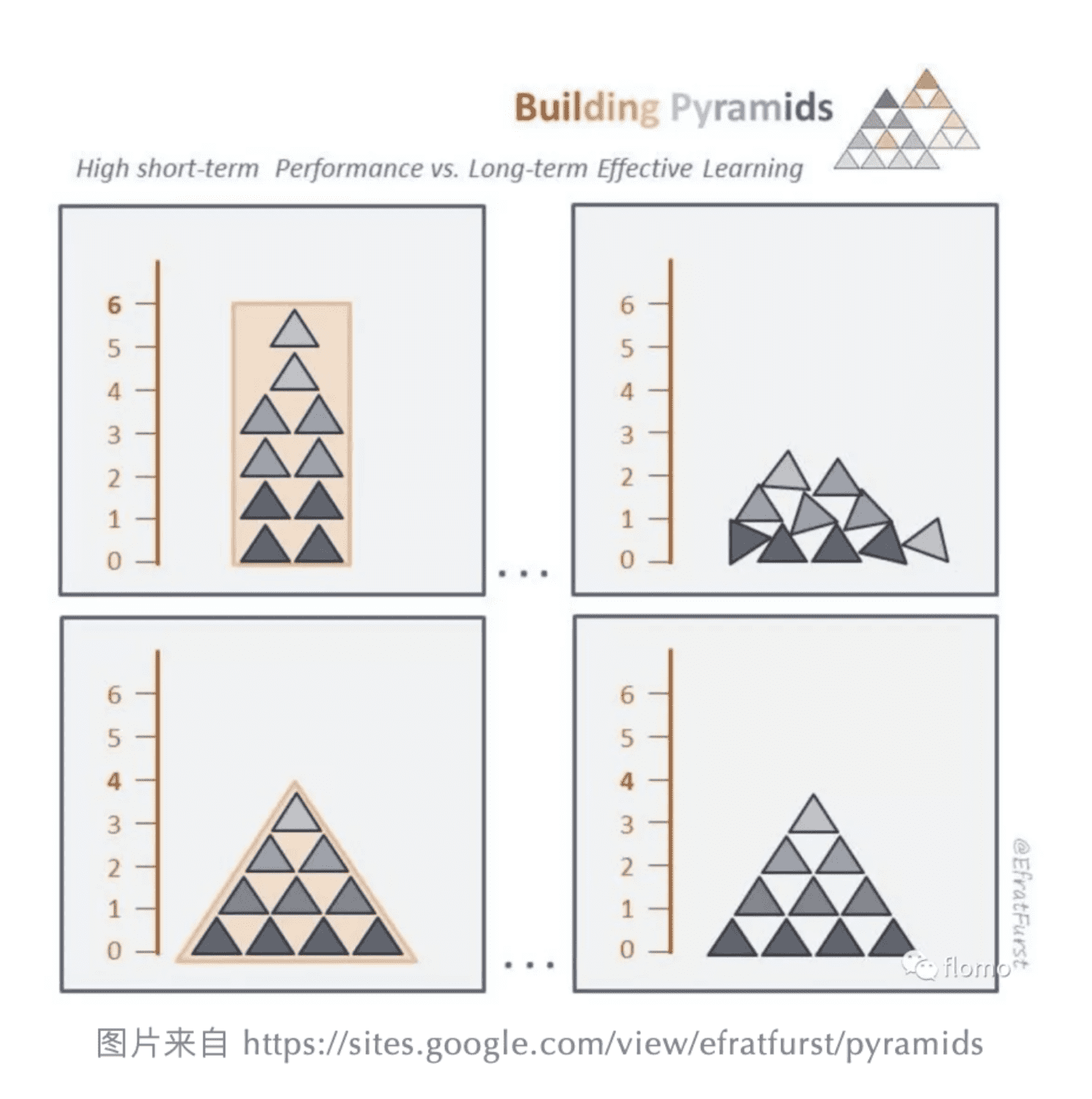
According to the picture above, when we want to reach a certain goal, there are several different methods. The two methods on the top are effective without firm foundations. But the method on the bottom of this picture is steady and showing connections among knowledge chunks.
**Honesty is important.**
Remembering the multiplication table is not equal to knowing multiplication. Finishing several Buddhism books is not equal to knowing the values of Buddhism. This is highly related to our learning results.
#### Reference:
# What Is Output?
Though surprised at the quick input, many users who started to use flomo may have the following confusion:
* My notes are fragmented. How can I output anything later?
* Outputting (writing) is hard. Is there any simple method?
* How can I integrate flomo with a certain app to help me write articles?
So what is on earth outputting? Though it is a familiar concept, we don’t completely understand it.
When it comes to “output”, we may think of writing articles and blogs, recording podcasts, or publishing books, which may give rise to different fears like “what if I am bad at writing”, “what if no one wants to read”, “what if I make mistakes”, etc. As the fears grow, we may believe that outputting is so hard that it is meaningless to write down notes. So we may transform the fears automatically into another question, that is, “how I can find a convenient tool to help me better at outputting”.
Here I didn’t want to criticize you anything. In my opinion, it is only because we don’t fully understand the concept of “output”.
Does outputting truly require your style of writing? Or is outputting the privilege of writers?
Perhaps you will have a different perspective after finishing this article.
### [**#**](https://help.flomoapp.com/thinking/output.html#%E8%BE%93%E5%87%BA%E6%98%AF%E4%B8%BA%E4%BA%86%E6%9B%B4%E5%A5%BD%E5%9C%B0%E5%86%B3%E7%AD%96)**Outputing is for making better decisions**
I guess most of you who read this article should be knowledge workers. Knowledge works should focus on quality rather than quantity, just as a teacher would focus on how much knowledge students understand rather than how many students he or she teaches.
The output of a knowledge worker, most of the time, is a better “decision”. In *Reason in Human Affairs* written by Herbert Simon, he illustrated the process of how a decision is made:
* First, your decisions are not comprehensive choices over large areas of your life, but are generally concerned with rather specific matters, assumed, whether correctly or not, to be relatively independent of other, perhaps equally important, dimensions of life.
* When you make a decision, no matter how important it is, you can not list all the possibilities.
* While making a decision, most of your efforts are spared on knowing facts including both the actual facts and your preference.
But what is the relationship between writing memos and making decisions? I’ll give you an example.
Though I grow older, I still don’t have any personal insurance, which is a latent risk for a family. But it could hardly attract any of my attention. Well, at that time, the insurance industry was notorious, and my parents were once tricked, which caused my bias toward insurance. So I didn’t make any decision on it at all.
Later I learned a course on investment from an app, and I read the knowledge about insurance once again. I had a habit of taking memos on flomo back then, so I took a few notes I learned from that course.

This memo didn’t generate any decision, but it was a seed plowed in my heart. It shifted my thought of “insurance is only for those who are afraid of death” to the thought of “insurance is for the financial security of my family. As a breadwinner, protecting myself is protecting my whole family”.
A few days later when I had a walk with an old friend along the river, we happened to discuss this insurance thing. He is interested in insurance and investment, so he gave me a flood of speeches on these two areas. I also took a memo.

This conversation really unveiled the mask of insurance for me, especially the medical insurance and dread disease insurance. He also corrected my opinions, that is, premiums are not the higher the better. I should consider my own income.
So acquiring the knowledge on insurance, I started to consider making a decision: to take out insurance. Since I am beginning to feel my age and I started to run a startup, I need to take out insurance to lower the financial risks for my family this year. Tomorrow or accident, nobody knows who will come first.
In this example, I didn’t output anything like articles, podcasts, or videos. But I output a decision based on the knowledge. For most of us, this is a kind of output. Without daily input and records, I am afraid I would never have time to study insurance.
Therefore, as a knowledge worker, your result of work is a decision. The problem is that you can never force yourself to think faster. You can only raise the quality of your decisions.
To summarize:
* The premise of decision quality is to have enough knowledge
* Enough knowledge comes from your daily accumulation
* To better accumulate your knowledge, it is important to capture ideas easily.
How to understand the third rule? Think about it, how could you absorb all the information if you save a ten-thousand-word article? Or how could you remember all the information you need if you don’t take any notes?
That’s why it is important to take notes on flomo. It is not for well-written articles but for better decisions.
### [**#**](https://help.flomoapp.com/thinking/output.html#%E8%BE%93%E5%85%A5%E5%B0%B1%E5%BA%94%E8%AF%A5%E5%A4%A7%E4%BA%8E%E8%BE%93%E5%87%BA)**Input should be greater than output**
When it comes to writing as a kind of output, we also have a few misunderstandings such as, what if these notes could not be used later? Should I continue to take notes since I still don’t know how to output after tons of memos?
I once read the article entitled *Walking as a Productivity System*, there is an inspiring paragraph:
“If you're trying to write an 80,000-word novel and you only write 80,000 words, it might be acceptable. But if you wrote 300,000 or 400,000 words and cut that back to 80,000, it’s almost certain that it would be a better novel.”
Similarly, many of our memos in flomo might not be used forever. Or many of them might be sporadic. But you see, in our lives, we need to do something that seems useless in order to find our true paths. It is the same while taking notes. All efforts are not made for nothing.
And here is another explanation, too. When we have no idea how to output anything, perhaps it is because we don’t have enough input. We don’t absorb as much information as possible to form our own structure. If you have more than a thousand memos in an area, maybe many problems will be solved automatically. I once wrote that an expert only has 50000 knowledge chunks (suppose that a memo is a chunk).
But please remember that there is no such an outputting tool to help you with the problem of not enough inputting. Sometimes when we find we could not output anything, the possible explanation is that we don’t have enough knowledge to do so.
Let go of the fear and anxiety about the future. Writing down everything on your mind in the present is more critical.
# A practice of Zettelkasten
The original article is written in Chinese and shared by one of flomo users, 机智的阿饭. We translate it into English. But parts of the images are his MEMOs and we didn’t modify them into the English version.
As a card memo tool, flomo helps this user to easily form the writing structure and write down articles faster. Let’s go deep into how he used flomo.

I read *How to Take Smart Notes* recently.
I heard the founder of flomo mention it several times. But I thought it was just a reference book. As a knowledge worker, I have read a lot of reference books like it. You know, reference books are sometimes inspiring, but you can’t expect them to bring changes to your life.
However, to my great surprise, I found a few overwhelming ideas while reading the introduction part of *How to Take Smart Notes*.
And more importantly, this book perfectly integrated the concepts of reading and note-taking. It is more than a reference book but an excellent process and system, which might change our life achievements.
So what is this miraculous note-taking system?
///
Before we dig into the answer, I’d like to briefly summarize this long article first. It can be divided into five parts:
1. The life of Luhmann and the birth of Zettelkasten
2. The simple process of Zettelkasten and the advanced one
3. Tool recommendation: Notion and flomo
4. Build your workflow first
5. Conclusion: simple is the ultimate principle
So let’s start.
### [**#**](https://help.flomoapp.com/thinking/smart-notes.html#_01-%E5%8D%A2%E6%9B%BC%E7%9A%84%E5%BC%80%E6%8C%82%E4%BA%BA%E7%94%9F-%E5%8D%A1%E7%89%87%E5%BC%8F%E7%AC%94%E8%AE%B0%E6%B3%95%E7%9A%84%E8%AF%9E%E7%94%9F)**01.** The life of Luhmann and the birth of Zettelkasten
(You can skip this part if you know Luhman well.)
Luhmann was a civil servant in Germany at first. After work, he went home and did something he enjoyed much, that is, reading and focusing on philosophy, the theory of organization, and sociology.
While taking notes, he realized that an idea or a note was valuable only in a context. But here the context was not from the original text.

So he started to think of a method, that is, how to make notes connect with different contexts.
He stopped adding notes to existing types or texts but took notes on cards. He also marked the cards and collected them on a slip box or “Zettlekasten” in German. The slip box had become his partner of conversation, the main creative origin, and the power of productivity. We can say that the slip box is a vital part of his success.
After that, his life became different.
Luhmann drafted the thoughts on the cards and then handed them off to the influential sociologist Helmut Schelsky in Germany.
Schelsky read Luhmann’s drafts and contacted him immediately. Schelsky suggested Luhmann teach sociology at Bielefeld University.
Please note that at this time, Luhmann was not a sociologist at all. Actually, according to his degree and work experiences, he was not even qualified for being an assistant of a sociologist. But Luhmann didn’t turn down this opportunity. Instead, he finished the dissertation of his Ph.D. and qualification with the help of the slip box in a year.
In 1968, Luhmann was selected as a professor at Bielefeld University for his lifetime.
Around 30 years later, Luhmann finished the last chapter of *Theory of Society*, which surprised the entire academy. This theory was a new aggressive one, which transformed sociology and inspired the discussion among philosophy, pedagogy, and psychology.
In these 30 years, he published 58 books and more than 100 essays (translations not included), most of which have become the classical content in relevant fields. After his death, his drafts in the office were sorted out. These drafts were later published as seven books about religion, education, and politics.
Luhmann’s experience is important because it is evidence of Zettelkasten’s value. But in order to take advantage of Zettelkasten, we need to rebuild our habit of reading and writing. But we could not make any change unless we fully understand the miracle of Zettelkasten.
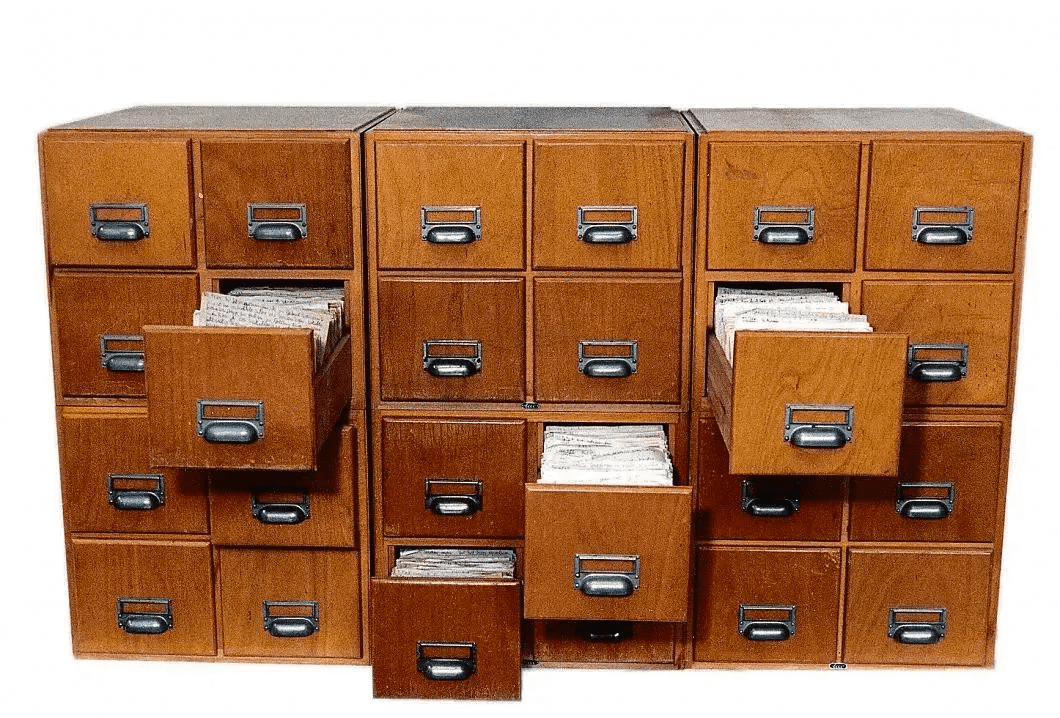
### [**#**](https://help.flomoapp.com/thinking/smart-notes.html#_02-%E5%8D%A1%E7%89%87%E7%AC%94%E8%AE%B0%E5%86%99%E4%BD%9C%E6%B3%95%E7%9A%84%E7%AE%80%E5%8D%95%E6%B5%81%E7%A8%8B)**02. A simple process of Zettelkasten**
Perhaps there are a few readers who don’t know how to apply the Zettelkasten in daily life, so I summarize a simple process here:
1. While studying, besides reading and taking lessons, you need to write down as many thoughts as possible in your own words (You don’t have to judge them. Just write down your questions and understandings).
2. Record all your thoughts and excerpts into one note-taker, e.g. flomo. Don’t categorize them in a hurry.
3. Review these cards or MEMOs from time to time. When you find a connection between two cards, then link them together.
4. When you have a thread of cards, try to draft an insightful article.
So this is the basics of Zettelkasten. Compared with the traditional linear writing steps, Luhmann emphasized more on preparing before writing.
He thought that a complete article was not finished in one’s brain. Our brain was not used to such a linear way of writing.
Zettelkasten also advocates capturing ideas.
You may have seen such a picture many times. What is your type while studying?

This picture reminded me of a friend. He loves reading and always sends me a few articles.
But when I asked him what he read, and why he loved it. He struggled to recall something but failed. He forgot most of them.
So in this pyramid of studying methods, reading, even in a concentrated state, could only store 10% of the information in our brain. I highly doubt whether we could store 5% while reading on a smartphone.·
Considering that the core of Zettelkasten is similar to Feynman's technique, which focuses on explaining and teaching others, Zettelkasten may increase the learning effectiveness to more than 50%.
To summarize, a simple step of explaining learning material on a card can increase our learning effectiveness more than ten times by simply reading.
In the world of lifelong learning, such learning effectiveness will bring a great advantage day by day.
* **Please note:**
Capture your ideas as much as possible. Try to write several cards every day.
Don’t worry about categorizing the notes or the value of each card. Just write down anything flowing in your mind. The process of Zettelkasten will transfer your cards into golden ideas. Trust it.
### [**#**](https://help.flomoapp.com/thinking/smart-notes.html#_03-%E8%BF%9B%E9%98%B6%E6%B5%81%E7%A8%8B-%E8%9E%8D%E5%85%A5%E7%9F%A5%E8%AF%86%E5%B7%A5%E4%BD%9C%E8%80%85%E7%9A%84%E5%BF%83%E5%BE%97%E6%8A%80%E5%B7%A7)**03. An advanced process: Combining Zettelkasten with knowledge worker’s workflow**
The advanced process is similar to the simple process. But as a knowledge worker, I just combined my workflow with Zettelkasten.
If you find it useful, you can build your own workflow.
#### [**#**](https://help.flomoapp.com/thinking/smart-notes.html#_1-%E4%B8%B4%E6%97%B6%E7%AC%94%E8%AE%B0-%E8%BE%B9%E5%AD%A6%E4%B9%A0%E8%BE%B9%E8%AE%B0%E5%BD%95%E9%87%8D%E7%82%B9)**1. Temporary notes: Taking notes while learning**
I believe many of you might have this habit. I just share with you how to make it more convenient.
* If the learning materials are easy, I will write down my complete notes rather than a few keywords. It’s a burden to organize the notes after learning. So if you can write down complete notes while studying, that’s better.
* If the learning materials are hard for me, I will write down a few key points, and understand them afterward. This can make us feel more joyful while learning something hard.
This is the benefit of building a workflow. You can do the things at the right time, and make the hard things easier.
* Trust your feelings and focus on the knowledge which inspires you a lot. Don’t learn something out of being afraid of missing out.
Now we are bombarded by information, which might make us stressed. We can just pick those things we really need. If some information is really important, we will meet again around the corner.
* I recommend you to read e-books. You can copy your notes to note-taking apps after finishing a book. Then you can move the books out of your e-reader, and test yourself if you truly understand them.
#### [**#**](https://help.flomoapp.com/thinking/smart-notes.html#_2-%E6%96%87%E7%8C%AE%E7%AC%94%E8%AE%B0-%E7%94%A8%E8%87%AA%E5%B7%B1%E7%9A%84%E8%AF%AD%E8%A8%80%E7%BF%BB%E8%AF%91%E5%8E%9F%E6%9D%90%E6%96%99)**2. Reference notes: Translate the original material in your own language**
Keep the reference notes short and simple. Choose them carefully and use your own language. Be picky about the reference. Do not take notes without understanding.
If you truly want to understand something, you have to transfer it into your own language. The thinking process should happen in your brain as well as on paper.
What is agreed by most professionals is that you have to materialize your thoughts, that is, write them down. Richard Feynman and Benjamin Franklin had the same opinion.
The author of *How to Take Smart Notes* reinforces the importance of explaining in your own words, which is considered the core of an increase in learning effectiveness. As for the reference notes, it is a tool to help us to understand the gist of texts in the process of Zettelkasten.
I used to read a lot of articles, books, and materials. I had loads of notes on note-takers. However, as a five-year blogger, I could say 95% of these excerpts are just excerpts. They had never appeared in my articles.
So next time when you take reference notes, remember to explain the notes in your own words after them. It can push you to fully understand the excerpted words so you may recall them faster when you need them.
While dealing with my temporary notes, I will ask myself the question “what is this paragraph talking about?” And then I will summarize them in my own words. If you are already familiar with this step, you can try to picture the way you teach others the points.
But at the first stage, I recommend you to write as free as possible. Don’t push yourself too hard. The best way to stick to doing something is to love it first.
#### [**#**](https://help.flomoapp.com/thinking/smart-notes.html#_3-%E6%B0%B8%E4%B9%85%E7%AC%94%E8%AE%B0-%E5%B0%86%E8%A6%81%E8%BF%9B%E8%A1%8C%E5%86%99%E4%BD%9C%E6%88%96%E8%80%85%E6%B7%B1%E5%BA%A6%E6%80%9D%E8%80%83%E7%9A%84%E4%B8%BB%E9%A2%98)**3 Permanent notes: A step before writing or deep thinking**
Review the notes you made before and consider the connection between your notes and your research or interests. The permanent notes are not for collecting materials but for generating ideas, thoughts, and discussions.
I have a process to deal with the reference notes written in my own words.
1. Some notes only increase my knowledge. I don’t have any thoughts on them. Then I will save them as reference notes and mark them with special tags.
2. Some notes trigger a few new thoughts. Then I will write them down and think of the connection between these new notes and the topics on permanent notes. If there is a suitable existing topic, I will put new notes under the topic.
3. If there is no suitable topic, then I will build a new one (or threads), and put notes under it to wait for more thoughts.
So there are many topics under my permanent notes. But not all of them are full of notes. Don’t try to fill them up in a hurry. As long as we keep reading, the permanent notes will be more complete.
Until one day we find there is a clear thread of the narrative, then we could move this thread of notes to the editor and start our writing.
It seems that the whole process is complicated, but it encourages us to use our learning habits and tools. So after a few deliberate practices, you will find it natural to do so.
The best part of Zettelkasten is that as long as you are practicing it, you can “automatically” publish insightful articles as many as possible.
Such positive feedback will encourage us to record more ideas, which is proof of an effective system.

* **Please note**
It is better to follow the above process in your energetic time, especially for the thinking and writing part.
I happened to listen to Plidezus’s live stream at 9 p.m. the other day. I was inspired but I felt tired, so I only wrote down a few keywords. However, when I got up the next morning, I felt so energetic that I wrote more than 2000 words of ideas.
Therefore, just rest and play when you are tired.
### [**#**](https://help.flomoapp.com/thinking/smart-notes.html#_04-%E5%B7%A5%E5%85%B7%E6%8E%A8%E8%8D%90-notion-flomo)**04. Tool recommended: Notion & flomo**
I agree with a sentence from *How to Take Smart Notes*: the tool is going to make things easier rather than more complicated.
So it is better to follow your own habit. The note-takers which support bi-directional links, such as Notion and Obsidian, are not easy to use. So it’s better to use them when you are more familiar with the process.
flomo is a lightweight note-taker I have used a lot this year. Notion is great for thematic content, while flomo is for popping-out ideas, which are the treasures of your future writing.
Only flomo can bring you an easy and free writing experience. Such an experience is created by flomo’s design, which is valuable in today’s world.
I transferred to Notion from Evernote this year. I found Notion suitable for permanent notes. It supports a simple quotation system, which is enough for now. I am looking forward to more visualized features.
### [**#**](https://help.flomoapp.com/thinking/smart-notes.html#_05-%E6%9C%80%E6%9C%80%E6%9C%80%E9%87%8D%E8%A6%81%E8%A6%81%E6%98%AF-%E5%BD%A2%E6%88%90%E6%80%BB%E4%BD%93%E5%B7%A5%E4%BD%9C%E6%B5%81%E7%A8%8B)**05. More importantly, build a workflow**
Specifically, Zettelkasten is not a technique of taking notes or a slip box. It is an effective workflow that helps us to think deeper and write better.
I introduced Zettelkasten in a detailed way because it is important to make clear how I use Zettelkasten in my own writing workflow.
Only when all of your work processes are connected and all the frictions are diminished can the effectiveness of Zettelkasten be shown.
In *How to Take Smart Notes*, there is a case of how Mclean’s containers change the world.
Containers were created a long time ago. However, it was not promoted until Mclean made efforts to formalize the industry including the companies which built them, warehouses, workers, trucks, ports, and ships in order to push them to optimize for containers. And after that, the cost of international freight was reduced by 95%.
It is similar when it comes to the value of Zettelkasten. We have to optimize our daily routines for this Zettelkasten workflow so it can benefit us the most.
Though I realized the importance of workflow before, I forgot to diminish the friction in the process and I didn’t change my habit to fit into this workflow. So my previous workflow didn’t bring me too much value.
After reading this book, I finally understood the importance of diminishing the friction in the process.
When could you say you have mastered the Zettelkasten?
Just see if you can finish each step in the process easily and joyfully and if you can find all kinds of topics for your writing.
### [**#**](https://help.flomoapp.com/thinking/smart-notes.html#%E5%86%99%E5%9C%A8%E6%9C%80%E5%90%8E) **Finally**
There are more inspiring thoughts in the book. For example, it suggests that do not consume your willpower to finish tasks because it can’t last for long. Make tasks push yourself forward (Chapter 2).

In a word, Zettelkasten is a method emphasizing simplicity.
Now, after completely understanding the above process, you can start to write down a few cards every day and save them to your note-takers.
Just do it.
### [**#**](https://help.flomoapp.com/thinking/smart-notes.html#reference)**Reference**
1. How to Take Smart Notes, Sönke Ahrens
2.
# A tag system to build flomo your second brain
This article is a practice shared by one of our users: [DEPYKUNG](https://sspai.com/u/depykung/updates)
Can flomo become your second brain? My answer is: it already is, though I know it is not perfect. “Second brain is a set of the knowledge management system, which means to save and protect your precious knowledge in a place outside your brain.” This article mainly discusses how flomo becomes my second brain and how to tag my notes in order to capture and create ideas faster.
## Love at the first sight
By following Plidezus on Jike App, I found the flomo he developed. Now, I can hardly recall any memory of applying for the beta test, but my first MEMO on flomo can reveal my excitement. On October 19th, 2020, I opened flomo and wrote down my first MEMO. At that time, I believed flomo would meet my demands. Well, it turns out I was right.
Having used flomo for 634 days, I have 629 MEMOs and 126 tags after constantly modifying and organizing my notes. While using flomo, I improve my notes and the structure of my second brain according to the guides on flomo 101.
## What do I use flomo?
Why we use a note-taker can be no more than capturing ideas, saving materials, taking reading notes, and project notes. And my notes will cover these four.
## Build my tag system
Though I belong to the gardener type while taking notes, I am sometimes the student type who likes collecting and accumulating information. And of course, I would like to keep an organized enough system (not as perfect as the architect type but yeah…). So building an effective tag system is the answer. There are a lot of flomo users sharing their tag systems. Different habits and areas generate various tag systems. I hope mine could be a reference to some of you.

#### First of all, the critical part of my tag system is the pinned tags. Making advantage of your pinned tags can accelerate the speed of adding them. There are four groups of my pinned tags: #Areas, #Creations, #Inbox, and #Resources. As for the #Content, I will talk about it later.
* Areas: Under this tag, there is knowledge of the various areas ranging from literature to business in the #Areas tag. I can add corresponding tags to almost all of my notes, which is convenient for me to review notes according to areas.
* Creations: it is mainly for my “creations”, specifically, writing, translation, videos, images, lyrics, and podcasts, which cover most categories of creators. I have a wide range of interests, so I tried them all.
* Inbox: it is mainly for the notes I am uncertain about the tags. Those notes could be tagged later when I review them.
* Resources: now it is a storage for knowledge. Most of the notes under this tag are my reading notes, not excerpts, but my thoughts while reading books. It is a vital step to write down your own thoughts. And under this tag, I also have a few subtags such as #Articles, #Movies, #Podcasts, #Recipes, #Thesis, etc.
#### What is #Content? When you have lots of tags, it is critical to organize your tags. One way is to pin a few tags. Another way is to categorize the common tags and make content, which is also a great way to improve the efficiency of tagging notes.

#### Tag your notes. The following pictures are all the tags after consideration. How cute they are after adding emojis!
So how to add tags to a note? Besides the category, the position of tags should be taken into consideration. The following are three methods of mine. You can make a choice according to your own habits.
* **Add tags in the beginning:** this method makes it easier to know which area this note belongs to. And its disadvantage is that the tag could be a barrier to your thinking flow. I recommend you to use bold and heading while using this method. It is useful and elegant (better to change a line).
* **Add tags at the end:** this method allows you to read the content first and add new thoughts and tags to the MEMO later. I also recommend you change a line while using it, which can increase the effectiveness of reviewing notes.
* **Insert tags in the sentence:** this method means you can add tags in the sentences while taking notes. It is great for divergent thinking but may make notes hard to read while sharing them on other platforms.


# How Does a Content Creator Take Reading Notes
This article is an interview with Chun Xiaoxi, a Malaysian Chinese content creator on YouTube. In this interview, she poured out all of her note-taking skills on flomo and her reading method. If you are going to be a content creator and a bookworm, you are gonna love this. Enjoy\~
***
**Q: Could you share with us your background?**
I am Chun Xiaoxi, a Malaysian Chinese, and a content creator. I have been running my YouTube channel all by myself for three years. Now I could support myself with the income, and I really enjoy my work and life. I mainly publish my videos on YouTube, and you can find me by searching the keywords “Xiaoxi’s Channel”.

While shooting videos, I will write scripts in advance. Most of my scripts for videos are similar to articles. And I am a book worm. Reading is my hobby and of course, my way to understand life.
**Q: So what are you reading lately?**
I have a wide range of choices. As for fiction, I love science fiction, mysteries, and classic literature; while for non-fiction, I love politics, social science, and popular science. Recently, I am reading *Range, Chaos, Why Buddhism is True*, *Seeing in the Dark,* and *Perfectly Reasonable Deviations from the Beaten Track*, and I am re-reading *The Ocean: Another Unknown Universe***.**
Part of the readings is for shooting videos. The subjects of my videos are mainly life and reading. Sometimes I talk about politics and news. Meanwhile, reading is also for entertaining myself and generating thoughts.
**Q: How do you use flomo while reading?**
I mentioned it in some of my videos.
> My habit is to take notes while reading. When I write enough words for a card, I’ll start a new one. So technically, you can split a book into tons of cards. As for those books without much information, maybe two or three cards will be enough.
>
> Normally, the first-level tag is “Book”, and then the name of the book, and that of the chapter. If necessary, I will add the page.
>
> I will write some comments. If my comment is short, I will use brackets and write my comment in it. Otherwise, I will change a line and label it as a comment.
>
> The advantage of comments is that you can distinguish the information and your understanding.
While reading, there is a difference between “next to a laptop” and not. And also, reading books is different from reading e-books.
It is convenient when you are reading next to a laptop. Say, while reading an e-book, you can split the screen on your laptop, and one screen for the book, another for flomo. So you can easily highlight notes, write down your thoughts, or link your notes on flomo.
If I am reading a paperback next to a laptop, there is not much difference. I still open flomo and take notes, which brings me into the zone. I won’t take excerpts of long paragraphs. But if they are short, I will directly type them on flomo.
When I don’t have a laptop at hand, it means I read in the room before I go to sleep. I have a loose-leaf notebook in the room, so I will write down those important notes in it. Later on, I transfer these notes to flomo.
**Q: Can you share with us a few of your reading notes?**
The following card is one of my reading notes. The sentences in the brackets are my comments.
(Note: considering the original notes are Chinese, we edit them into English)

I will summarize all of the notes I take into one card, which is easy to generate some insights.
It is similar to this index card of *A Hundred Ways of Reading*. Well, this book doesn’t have a category. Since there are a hundred ways, I think perhaps I could categorize them by myself. So I put all the similar ways of reading together. After finishing that, I wonder how they can connect with each other. So I summarize all cards of reading methods together into one card. And here it is.

Well, most of the time, such connections are cross-books. So I will use the tag #Books/0/Connections to mark the notes, or I will use #Permanent/Connections.

**Q: So when will you make such an index card? Or say, what goal do you want to achieve by making such a card?**
Xiaoxi: For sparks, you know. Just try to put them together and see what’s gonna happen. Maybe something fun! I personally think it is a good way to generate insights, so you can try it as well.
**Q: What do you do after taking these reading notes?**
1. Sometimes when I take notes, I already have a topic or area in mind. So I will tag the notes with specific areas. If the card only has the name of the book, which means it is uncategorized, I will leave it for later review.
But I won’t categorize the card unless I have a clear thought of putting it in which area.
If reviewing notes is for testing my storage and retrieval of information, I will write down all my memory about this book on another card. And then I will check my previous notes to see if I got all of them.
Actually, if you are clear about which area this card should be put into, then just set tags directly. You don’t have to put the card under #Books or #Documents, which are meaningless categories. **Because where notes are from is not as important as where to use notes.** If you only tag your notes with their origins, perhaps you are just “collecting” notes.
But here is a problem. The reason why I take notes can hardly be clear while I am taking them. It takes time to reveal the meaning of notes. So it is not a good idea to categorize notes immediately.
In such a circumstance, #Books and #Documents are equal to a thought cache that contain uncategorized notes.
1. After finishing a book, I may read some relevant materials such as interpretations. For example, when I finished *Metamorphosis*, I went to find a few interpretations and add more notes.
2. Notes could be the materials for writing articles or say, a library for creators. It can generate a large number of ideas and insights.
3. Taking notes allows you to be in the zone. You can’t remember what you don’t understand at all, so taking notes can help you to absorb the information.
**Q: What experiences can you share with us?**
1. Sometimes I will put serial numbers in my reading notes. One reason is that it is easier to read. Another reason is that when I annotate and link the MEMOs, I will know which number of notes I annotate.
2. I didn’t take very long reading notes, but after much practice, now I can write several hundred words on a card. And as for those complicated and unfamiliar concepts, I can even write down more than a thousand words.
I will put my paraphrases, original materials, my comments, understandings, and thoughts all into one card, just like the following one.
While reviewing notes, I will organize the cards by deleting a few unnecessary sentences and adding something new.
1. I have been used to opening flomo in several tabs. One is for writing a diary, one is for taking reading notes, another for taking permanent notes, etc. So when I am taking notes, I will link these notes or add some new thoughts.
**Q: Does flomo bring any change to your work or life?**
Of course! It is assuring you to save all the things you need to remember in one place. Taking permanent notes make me get used to “capturing thoughts and categorizing them”. I used to write in my diary but I didn’t categorize notes, which was not sustainable.
Besides, I find that after using flomo, I am better at citation.
In one of my videos, I cited about 20 books for reference. I was astonished. Perhaps this is the compound interest of knowledge. Since I am interested in various topics, flomo allows me to take several or tons of cards all by my wish. Now I am reading with the freedom of wandering among books like a bee gathering honey in the book garden.
I am also learning to organize better documents, achieved on flomo. I feel great using it.
# flomo PRO
flomo's business model is simple: users buy PRO membership. So we don't sell your data, and you won't see ads inside flomo's products in the future.
Purchasing a PRO membership will make flomo's service last for longer. Through subscription, our relationship has changed from simply free use to a paid contract. We will continue to offer more services to our PRO members. Thank you for your support.
{% content-ref url="/pages/-MhLzYTAAHwyp8pPiSka" %}
[Membership Agreement](/terms-and-privacy/terms/membership-agreement)
{% endcontent-ref %}
## Comparison between Free & PRO
| `Input` | | |
| ------------------ | ---------- | --------- |
| Tag system | ✅ | ✅ |
| WeChat input | ✅ | ✅ |
| Heat Map | ✅ | ✅ |
| All platforms sync | ✅ | ✅ |
| | | |
| `storage` | | |
| Text | unlimited | unlimited |
| Image Storage | 500 M | 10 G |
| Image Compression | Compressed | Original |
| Export | ✅ | ✅ |
| | | |
| `Advanced` | | |
| Daily Review | 🚫 | ✅ |
| API | 🚫 | ✅ |
| Backlinks | 🚫 | ✅ |
| Tag ICON | 🚫 | ✅ |
## Feedback
We're looking forward to your feedback. [Click here to give feedback.](http://flomoapp.mikecrm.com/n8Q5VtN) Or join our [discord](https://discord.gg/z2wHUKjab2)
# Redeem PRO
If you get the PRO redemption code from other channels, such as media or friends, you can follow the steps below to redeem.


## Feedback
We're looking forward to your feedback. [Click here to give feedback.](http://flomoapp.mikecrm.com/n8Q5VtN) Or join our [discord](https://discord.gg/z2wHUKjab2)
# Terms
Updated: Jun 26, 2021
### Hi, flomoers
Thanks for using our products and services ("Services"). The Services are provided by flomo team (Created by Plidezus & Lightory) ("flomo"). By using our Services, you are agreeing to these terms. Please read them carefully. IF YOU DO NOT AGREE TO THESE TERMS, PLEASE DO NOT USE THE SERVICES.
These terms govern your use of flomo's product flomo, including its features, apps, services, technologies, and software we offer, except where we expressly state that separate terms (and not these) apply.
## Using our Services
You must follow any policies made available to you within the Services.
Don't misuse our Services. For example, don't interfere with our Services or try to access them using a method other than the interface and the instructions that we provide. You may use our Services only as permitted by law, including applicable export and re-export control laws and regulations. We may suspend or stop providing our Services to you if you do not comply with our terms or policies or if we are investigating suspected misconduct.
Using our Services does not give you ownership of any intellectual property rights in our Services or the content you access. You may not use content from our Services unless you obtain permission from its owner or are otherwise permitted by law. These terms do not grant you the right to use any branding or logos used in our Services. Don't remove, obscure, or alter any legal notices displayed in or along with our Services.
In connection with your use of the Services, we may send you service announcements, administrative messages, and other information. You may opt out of some of those communications.
## Your flomo Account
You may need a flomo Account in order to use some of our Services. To protect your flomo Account, keep your password confidential. You are responsible for the activity that happens on or through your flomo Account. Try not to reuse your flomo Account password on third-party applications.
## Privacy and Copyright Protection
flomo's [Privacy Policy](/terms-and-privacy/privacy) explains how we treat your personal data and protect your privacy when you use our Services. By using our Services, you agree that flomo can use such data in accordance with our privacy policies.
## Your Content in Our Services
Some of our Services allow you to create, upload, submit, save, send or receive content. You retain ownership of any intellectual property rights that you hold in that content. In short, what belongs to you stays yours.
You can find more information about how flomo uses and stores content in the [Privacy Policy ](/terms-and-privacy/privacy)or additional terms for particular Services. If you submit feedback or suggestions about our Services, we may use your feedback or suggestions without obligation to you.
## About Software in Our Services
When a Service requires or includes downloadable software, this software may update automatically on your device once a new version or feature is available. Some Services may let you adjust your automatic update settings.
flomo gives you a personal, worldwide, royalty-free, non-assignable and non-exclusive license to use the software provided to you by flomo as part of the Services. This license is for the sole purpose of enabling you to use and enjoy the benefit of the Services as provided by flomo, in the manner permitted by these terms. You may not copy, modify, distribute, sell, or lease any part of our Services or included software, nor may you reverse engineer or attempt to extract the source code of that software, unless laws prohibit those restrictions or you have our written permission.
## Modifying and Terminating Our Services
We may modify these terms or any additional terms that apply to a Service to, for example, reflect changes to the law or changes to our Services. You should look at the terms regularly. We'll post notice of modifications to these terms on this page. Changes will not apply retroactively and will become effective no sooner than fourteen days after they are posted. However, changes addressing new functions for a Service or changes made for legal reasons will be effective immediately. If you do not agree to the modified terms for a Service, you should discontinue your use of the Service.
If there is a conflict between these terms and the additional terms, the additional terms will control for that conflict.
## Our Warranties and Disclaimers
We provide our Services using a commercially reasonable level of skill and care and we hope that you will enjoy using them. But there are certain things that we don't promise about our Services.
OTHER THAN AS EXPRESSLY SET OUT IN THESE TERMS OR ADDITIONAL TERMS, NEITHER flomo NOR ITS SUPPLIERS OR DISTRIBUTORS MAKE ANY SPECIFIC PROMISES ABOUT THE SERVICES.
SOME JURISDICTIONS PROVIDE FOR CERTAIN WARRANTIES, LIKE THE IMPLIED WARRANTY OF MERCHANTABILITY, FITNESS FOR A PARTICULAR PURPOSE AND NON-INFRINGEMENT. TO THE EXTENT PERMITTED BY LAW, WE EXCLUDE ALL WARRANTIES.
## Limits on Liability
We work hard to provide the best Products we can and to specify clear guidelines for everyone who uses them. However, THE SERVICE IS PROVIDED "AS IS".
\
WE CANNOT PREDICT WHEN ISSUES MIGHT ARISE WITH OUR SERVICES. ACCORDINGLY, OUR LIABILITY SHALL BE LIMITED TO THE FULLEST EXTENT PERMITTED BY APPLICABLE LAW, AND UNDER NO CIRCUMSTANCE WILL WE BE LIABLE TO YOU FOR ANY LOST PROFITS, REVENUES, INFORMATION, OR DATA, OR CONSEQUENTIAL, SPECIAL, INDIRECT, EXEMPLARY, PUNITIVE, OR INCIDENTAL DAMAGES ARISING OUT OF OR RELATED TO THESE TERMS OR THE flomo PRODUCTS, EVEN IF WE HAVE BEEN ADVISED OF THE POSSIBILITY OF SUCH DAMAGES. YOUR USE AND/OR PURCHASE OF SERVICE ARE ALL AT YOUR SOLE RISK.
## Business Uses of Our Services
If you are using our Services on behalf of a business, that business accepts these terms. It will hold harmless and indemnify flomo and its affiliates, officers, agents, and employees from any claim, suit or action arising from or related to the use of the Services or violation of these terms, including any liability or expense arising from claims, losses, damages, suits, judgments, litigation costs and attorneys' fees.
## About These Terms
These terms control the relationship between flomo and you. They do not create any third party beneficiary rights. If you do not comply with these terms, and we don't take action right away, this doesn't mean that we are giving up any rights that we may have (such as taking action in the future).If it turns out that a particular term is not enforceable, this will not affect any other terms.
For more information, please [contact](mailto:support@flomo.app) us
Thanks to [ticktick](https://ticktick.com/) for providing the base version of this terms.
# Membership Agreement
Updated: Aug 18, 2021
### Hi, flomoers
Thanks for using our products and services ("Services"). The Services are provided by flomo team (Created by Plidezus & Lightory) ("flomo"). By using our Services, you are agreeing to these terms. Please read them carefully. IF YOU DO NOT AGREE TO THESE TERMS, PLEASE DO NOT USE THE SERVICES.
This Agreement is deemed to be a supplement to [flomo Terms](/terms-and-privacy/terms), and an integral part of, the flomo User and Privacy Agreement and constitutes a unified whole.
If there is a conflict between these Rules and the flomo User and Privacy Agreement, the contents of this Agreement shall prevail. Your use of the Service Agreement shall be deemed to constitute acceptance of the Service Agreement, including any modifications to the Service Agreement made by flomo from time to time.
## Subscriptions
Some parts of the Service are billed on a subscription basis ("Subscription(s)"). You will be billed in advance on a recurring and periodic basis ("Billing Cycle"). Billing cycles are set either on a monthly or annual basis, depending on the type of subscription plan you select when purchasing a Subscription.
At the end of each Billing Cycle, your Subscription will automatically renew under the exact same conditions unless you cancel it or flomo. cancels it. You may cancel your Subscription renewal either through your online account management page or by contacting flomo.
A valid payment method, including credit card, is required to process the payment for your Subscription. You shall provide flomo with accurate and complete billing information including full name, address, state, zip code, telephone number, and a valid payment method information. By submitting such payment information, you automatically authorize flomo to charge all Subscription fees incurred through your account to any such payment instruments.
Should automatic billing fail to occur for any reason, flomo. will issue an electronic invoice indicating that you must proceed manually, within a certain deadline date, with the full payment corresponding to the billing period as indicated on the invoice.
## Subscriptions Price
Price may vary by location. Subscriptions will be charged to your credit card through your iTunes account. Your subscription will automatically renew unless canceled at least 24 hours before the end of the current period. You will not be able to cancel the subscription once activated. After purchase, manage your subscriptions in App Store Account Settings. Any unused portion of a free trial period, will be forfeited when the user purchases a subscription.
## Subscriptions Fee Changes
flomo in its sole discretion and at any time, may modify the Subscription fees for the Subscriptions. Any Subscription fee change will become effective at the end of the then-current Billing Cycle.
flomo will provide you with a reasonable prior notice of any change in Subscription fees to give you an opportunity to terminate your Subscription before such change becomes effective.
Your continued use of the Service after the Subscription fee change comes into effect constitutes your agreement to pay the modified Subscription fee amount.
## How to cancel subscriptions
If you choose the continuous monthly (or annual) service, you can suspend or terminate the service in the following ways: Apple in-app payment (IAP payment, in-app purchase) auto-renewal user unsubscribe as follows: open the Apple phone "Settings" -> go to "iTunes Store and App Store" -> click "Apple ID", select "View Apple ID ", enter the "Account Settings" page, click "Subscriptions", and cancel the subscription of "flomo membership service".
flomo has the right to adjust the term, price and related contents of the existing membership continuous monthly subscription according to the user's needs, changes in products and service contents, etc., in order to continuously improve and optimize the service. If users have any questions about the content of this Terms of Service, they can send an email to ().
# Privacy Policy
Updated: Jun 26, 2021
### Hi, flomoers
Thanks for using our products and services ("Services"). The Services are provided by flomo team (Created by Plidezus & Lightory). ("flomo"). By using our Services, you are agreeing to these terms. Please read them carefully. IF YOU DO NOT AGREE TO THESE TERMS, PLEASE DO NOT USE THE SERVICES.
Since the beginning of the creation of flomo.app , the user's data security has been given top priority. This privacy policy mainly explains where your data is stored, how we keep it safe, and some things you care about.
If you decide to use the services provided by our products, this agreement is used to inform us how to collect, use and disclose the privacy of users.
If you choose to use the services we provide, you agree to collect and use the information related to this policy. The personal information we collect is used to provide and improve services. Unless otherwise stated in this privacy policy, we will not use or share your information with anyone.
Unless otherwise stated in this privacy policy, the terms used in this privacy policy have the same meaning as our terms and conditions and can be accessed on the official website of flomo.
####
## **1.** WHO OWNS THE DATA?
The goal of flomo is to provide stable, reliable and convenient cloud note service and a good experience for all Internet users. The user has complete ownership and use rights for the data on the flomo. I know that technology, cloud service providers and any third parties have no right to use your data.
## **2. WHAT INFORMATION DO WE COLLECT?**
**Personal information you disclose to us**
We collect personal information that you voluntarily provide to us when you register on the Services, express an interest in obtaining information about us or our products and Services, when you participate in activities on the Services or otherwise when you contact us.
The personal information that we collect depends on the context of your interactions with us and the Services, the choices you make and the products and features you use. The personal information we collect may include the following:
### **Personal Information Provided by You.**
We collect names; phone numbers; email addresses; contacts; and other similar information.
We take the protection of personal information of minors very seriously. If you are a minor under the age of 14, before using our services, you should ensure that you obtain the consent of the guardian in advance. If you are a minor who has reached the age of 14 and under 18, you must ensure that you obtain in advance before using our services I or the guardian's consent. If we learn that personal data of children under 14 years of age have been collected, we will take all reasonable steps to delete the data as soon as possible. If you know that your child provided us with personal information without your consent, please contact us.
### **Information automatically collected**
We automatically collect certain information when you visit, use or navigate the Services. This information does not reveal your specific identity (like your name or contact information) but may include device and usage information, such as your IP address, browser and device characteristics, operating system, language preferences, referring URLs, device name, country, location, information about how and when you use our Services and other technical information. This information is primarily needed to maintain the security and operation of our Services, and for our internal analytics and reporting purposes.
Like many businesses, we also collect information through cookies and similar technologies.
The information we collect includes:
* *Log and Usage Data.* Log and usage data is service-related, diagnostic, usage and performance information our servers automatically collect when you access or use our Services and which we record in log files. Depending on how you interact with us, this log data may include your IP address, device information, browser type and settings and information about your activity in the Services (such as the date/time stamps associated with your usage, pages and files viewed, searches and other actions you take such as which features you use), device event information (such as system activity, error reports (sometimes called 'crash dumps') and hardware settings).
* *Device Data.* We collect device data such as information about your computer, phone, tablet or other device you use to access the Services. Depending on the device used, this device data may include information such as your IP address (or proxy server), device and application identification numbers, location, browser type, hardware model Internet service provider and/or mobile carrier, operating system and system configuration information.
### **Information collected through our App**
If you use our App, we also collect the following information:
* *Mobile Device Data.* We automatically collect device information (such as your mobile device ID, model and manufacturer), operating system, version information and system configuration information, device and application identification numbers, browser type and version, hardware model Internet service provider and/or mobile carrier, and Internet Protocol (IP) address (or proxy server). If you are using our App, we may also collect information about the phone network associated with your mobile device, your mobile device’s operating system or platform, the type of mobile device you use, your mobile device’s unique device ID and information about the features of our App you accessed.
* *Push Notifications.* We may request to send you push notifications regarding your account or certain features of the App. If you wish to opt-out from receiving these types of communications, you may turn them off in your device's settings.
This information is primarily needed to maintain the security and operation of our App, for troubleshooting and for our internal analytics and reporting purposes.
## **3. HOW DO WE USE YOUR INFORMATION?**
We use personal information collected via our Services for a variety of business purposes described below. We process your personal information for these purposes in reliance on our legitimate business interests, in order to enter into or perform a contract with you, with your consent, and/or for compliance with our legal obligations. We indicate the specific processing grounds we rely on next to each purpose listed below.
We use the information we collect or receive:
* **Request feedback.** We may use your information to request feedback and to contact you about your use of our Services.
* **To manage user accounts.** We may use your information for the purposes of managing our account and keeping it in working order.
* **To send administrative information to you.** We may use your personal information to send you product, service and new feature information and/or information about changes to our terms, conditions, and policies.
* **To protect our Services.** We may use your information as part of our efforts to keep our Services safe and secure (for example, for fraud monitoring and prevention).
* **To enforce our terms, conditions and policies for business purposes, to comply with legal and regulatory requirements or in connection with our contract.**
* **To respond to legal requests and prevent harm.** If we receive a subpoena or other legal request, we may need to inspect the data we hold to determine how to respond.
* **Fulfill and manage your orders.** We may use your information to fulfill and manage your orders, payments, returns, and exchanges made through the Services.
* **Administer prize draws and competitions.** We may use your information to administer prize draws and competitions when you elect to participate in our competitions.
* **To deliver and facilitate delivery of services to the user.** We may use your information to provide you with the requested service.
* **To respond to user inquiries/offer support to users.** We may use your information to respond to your inquiries and solve any potential issues you might have with the use of our Services.
* **For other business purposes.** We may use your information for other business purposes, such as data analysis, identifying usage trends, determining the effectiveness of our promotional campaigns and to evaluate and improve our Services, products, marketing and your experience. We may use and store this information in aggregated and anonymized form so that it is not associated with individual end users and does not include personal information. We will not use identifiable personal information without your consent.
## **4. WILL YOUR INFORMATION BE SHARED WITH ANYONE?**
We may process or share your data that we hold based on the following legal basis:
* **Consent:** We may process your data if you have given us specific consent to use your personal information for a specific purpose.
* **Legitimate Interests:** We may process your data when it is reasonably necessary to achieve our legitimate business interests.
* **Performance of a Contract:** Where we have entered into a contract with you, we may process your personal information to fulfill the terms of our contract.
* **Legal Obligations:** We may disclose your information where we are legally required to do so in order to comply with applicable law, governmental requests, a judicial proceeding, court order, or legal process, such as in response to a court order or a subpoena (including in response to public authorities to meet national security or law enforcement requirements).
* **Vital Interests:** We may disclose your information where we believe it is necessary to investigate, prevent, or take action regarding potential violations of our policies, suspected fraud, situations involving potential threats to the safety of any person and illegal activities, or as evidence in litigation in which we are involved.
* **Vendors, Consultants and Other Third-Party Service Providers.** We may share your data with third-party vendors, service providers, contractors or agents who perform services for us or on our behalf and require access to such information to do that work. Examples include: payment processing, data analysis, email delivery, hosting services, customer service and marketing efforts. We may allow selected third parties to use tracking technology on the Services, which will enable them to collect data on our behalf about how you interact with our Services over time. This information may be used to, among other things, analyze and track data, determine the popularity of certain content, pages or features, and better understand online activity. Unless described in this notice, we do not share, sell, rent or trade any of your information with third parties for their promotional purposes.
## **5. WHO WILL YOUR INFORMATION BE SHARED WITH?**
We only share and disclose your information with the following third parties. We have categorized each party so that you may be easily understand the purpose of our data collection and processing practices. If we have processed your data based on your consent and you wish to revoke your consent, please contact us using the contact details provided in the section below titled "HOW CAN YOU CONTACT US ABOUT THIS NOTICE?".
* **Cloud Computing Services**
* **Functionality and Infrastructure Optimization**
* **Web and Mobile Analytics**
## **6. DO WE USE COOKIES AND OTHER TRACKING TECHNOLOGIES?**
We may use cookies and similar tracking technologies (like web beacons and pixels) to access or store information. Specific information about how we use such technologies and how you can refuse certain cookies is set out in our Cookie Notice.
## **7. HOW LONG DO WE KEEP YOUR INFORMATION?**
We will only keep your personal information for as long as it is necessary for the purposes set out in this privacy notice, unless a longer retention period is required or permitted by law (such as tax, accounting or other legal requirements). No purpose in this notice will require us keeping your personal information for longer than the period of time in which users have an account with us.
When we have no ongoing legitimate business need to process your personal information, we will either delete or anonymize such information, or, if this is not possible (for example, because your personal information has been stored in backup archives), then we will securely store your personal information and isolate it from any further processing until deletion is possible.
## **8. HOW DO WE KEEP YOUR INFORMATION SAFE?**
We have implemented appropriate technical and organizational security measures designed to protect the security of any personal information we process. However, despite our safeguards and efforts to secure your information, no electronic transmission over the Internet or information storage technology can be guaranteed to be 100% secure, so we cannot promise or guarantee that hackers, cybercriminals, or other unauthorized third parties will not be able to defeat our security, and improperly collect, access, steal, or modify your information. Although we will do our best to protect your personal information, transmission of personal information to and from our Services is at your own risk. You should only access the Services within a secure environment.
## **9. HOW CAN YOU REVIEW, UPDATE, OR DELETE THE DATA WE COLLECT FROM YOU?**
Based on the applicable laws of your country, you may have the right to request access to the personal information we collect from you, change that information, or delete it in some circumstances. To request to review, update, or delete your personal information, please email us at . We will respond to your request within 30 days.
## **10. DO WE MAKE UPDATES TO THIS NOTICE?**
We will modify the privacy policy from time to time, and any of our modifications will be based on protecting the user's information security. We encourage you to check our privacy policy every time you visit the webpage of flomo, so as to keep abreast of it.
## **11. HOW CAN YOU CONTACT US ABOUT THIS NOTICE?**
If you have any questions or concerns about this privacy statement, you can send an email to at any time to contact me for your notes.
# About Us
## Why the name flomo?
flomo = flow + memo
## Who is the development team behind it?

flomo was originally designed and developed by Plidezus and Lightory.We have been friends for ten years.
At a winter day, we reached a consensus that we didn't want to chase after the number of users, revenue and valuation this time.
Instead, we wanted to pursue the idea that flomo could be decent and exist for as long as possible.
Other team members.
* HH: iOS engineer
* DK: Android engineer
# The Long-termism of A Note-taking Service
At a night in the winter of 2021, while having a hotpot with Plidezus, we joyfully agreed that the ultimate goal of building flomo is not the quantity of users, the revenue, or the estimated value.
Instead, what we are pursuing is that flomo could sustain decently as long as possible.
This is more than talk. It will influence each decision we made.
### No funding
Honestly, flomo still raise zero funding till today. We pledged our own money in the earlier stage, now it could pay for itself.
Though a few venture capitals and some friends of angel investments showed their interests since last year, we refused all of them.
There are quiet a few users believing that only funding could lead to a guaranteed service. Nevertheless, we won’t choose such a path. I reckon they only see the exterior situation rather than the truth.
It is easy to ignore the cost of funding while being overshadowed by the light of it.
Simply speaking, the money is not coming from nowhere. The capital has their own wishes, the core of which is return. The venture capitals that invest in startups will require a pretty high return considering they are in face of a high risk. Sometimes they expect to have hundred-fold or thousand-fold returns.
I am not saying this is wrong. It’s righteous. If a company’s business is prospecting enough and it could win a few key developmental elements by funding, then it is reasonable to cooperate with venture capital, which means they could both get rewards from this collaboration.
To be frank, note-taker is not a business with a high ceiling that venture capitals can hardly get what they want from. And of course I don’t see any necessities in this business requiring funding.
So what will happen if a business with a not high ceiling collaborates with a venture capital demanding for high returns? There are quiet a few examples speaking for themselves.
Many brands are devastated under such circumstances.
We don’t expect such a thing to happen on flomo.
To flomo, no funding is a way of sticking to long-termism.
As for those friends from angel investing, they are willing to support flomo out of trust. We appreciate that very much, and we do hope to bring good enough returns to them. However, we are not that confident to make such a commitment. So we could only turn them down.
### Cost control
Ability minus desire is freedom.
So, first, do not make your desire exceed your ability; second, continuously improve your ability.
It is a common rule that could be applied to people as well as to companies. Companies are facing more difficult challenges. It is hard to be threatened by survival for most people, while for companies, they are threatened by it every day.
Therefore, flomo has a very strict control of cost.
It is known to all that flomo only has two full-time staff. One reason is that we both are competent to carry out the work (I am not showing off!). But another reason is the survival.
We apply the rule of cost-control to almost everything. Say, why don’t we use SMS for login? Because it takes money. And for a long time, we only use an “out-of-dated” single-core server. It is so diligent that covers almost everything. Not until a few days ago did we use more than one server. And there are a few standard services not being equiped. For example, though we have studies the ElasticSearch for several months, we still didn’t deploy it. Our friends were astonished. Well, it takes time and money to do so. At least we are running fine.
We haven’t been so belt-tightening in our whole lives 🤦♂️. But this provides flomo strong survivability as well as freedom, which allows us to pursue what we truly want.
### Subscription
flomo will never rely on profits on advertising. In a business model of advertising, the advertisers are true users. While users’ attention is a commodity an app provides to advertisers. This runs counter to the problem we want to solve for our uers.
That’s why we choose subscription as our main business model. Each year or month you pay a few dollars for PRO membership, and you can cancel it when you feel you don’t get what you want.
We never encourage you to pay for a multiple-year PRO membership in advance because we hope you can have the right to cancel it.
Well, it is a kind of pressure to sustain your subscription, but it is worthwhile.
### Contribution and rewards
Now you have understood three general rule of us operating flomo:
* No funding
* Cost control
* Only subscription
We know we are not saints. So by conforming with all these rules, we could achieve our ultimate goal: to survive as long as possible with decency.
And we believe that we will see enough returns if we stick to these right choices and providing values to you.
As one of our friends once metaphorized:
Returns are the shadowns of contribution,
I mean, if being arranged properly.
When you chase the sun, the shadow follows you.
But if you chase the shadows, you will be apart from the sun.
Away from the light means away from the shadows eventually.
### Serving another seven years
Many users once consulted whether they could buy permanent PRO membership.
We understand their points and selling permanent PRO membership could raise our incomes evidently. But we always tell our users that flomo will not offer permanent PRO membership.
Besides the right to cancel subscription I mentioned above, a more important reason is that we won’t make any commitment if we don’t have confidence.
But there is one thing we are very sure of, that is, we will reserve service guarantee deposit to cover another seven-year service of servers and labor cost.
Only when we have to give up on flomo (well, not possible really), which generates the state of sustaining flomo, will this deposit be used. And if the server and labor cost increases, we will definitely increase more into this deposit.
This means we make a commitment every day that we will serve you another seven years until we can’t make this commitment at all.
Perhaps seven years is not long enough, but this is what we could offer right not. If we are more capable, we expect to add this duration to 20 years.
Besides this, we also provide the data export feature, which is exclusive to PRO members previously, to all our users. But considering controlling the cost, we have made restriction, which is that you can only export every seven days. I believe this is enough for most of you.
### Finally
Well, we don’t want you to subscribe to flomo after reading this article or any other articles. It is not necessary. The only reason you should subscribe to flomo is that flomo does provide values to you.
If flomo doesn’t satisfy your needs, then it should come to an end.
This is the path we chose.
# Feedback
We're looking forward to your feedback.
[Click here to give feedback](http://flomoapp.mikecrm.com/n8Q5VtN)
Or join our [discord](https://discord.gg/z2wHUKjab2)
